Picture this: it’s a beautiful Sunday afternoon. You are cruising through the local park on your mobility scooter, enjoying the sunshine, or maybe you are finally tackling that overgrown lawn on your electric riding mower. You are miles away from an outlet when, suddenly, the power gauge plummets to zero. You hear a pathetic whine from the motor, and you are left stranded, staring down a judgmental squirrel while waiting for a tow. If this sounds painfully familiar, it is time to face the music—your deep-cycle power source is officially dead.
When it comes to powering heavy-duty mobility equipment, off-grid solar setups, or industrial floor scrubbers, the Group 22NF battery is the undisputed workhorse of the industry. But replacing it isn’t quite as simple as grabbing AA batteries for your TV remote. You are dealing with serious voltage, strict space limitations, and a confusing alphabet soup of chemical technologies. In this ultimate guide, we are going to tear down absolutely everything you need to know about the 22NF. We will cover the hard technical data, compare it with alternative sizes, walk you through a safe replacement process, and even dive into the best storage practices so you don’t accidentally ruin your new investment over the winter.
Technical Specifications: The Rigid BCI Standards
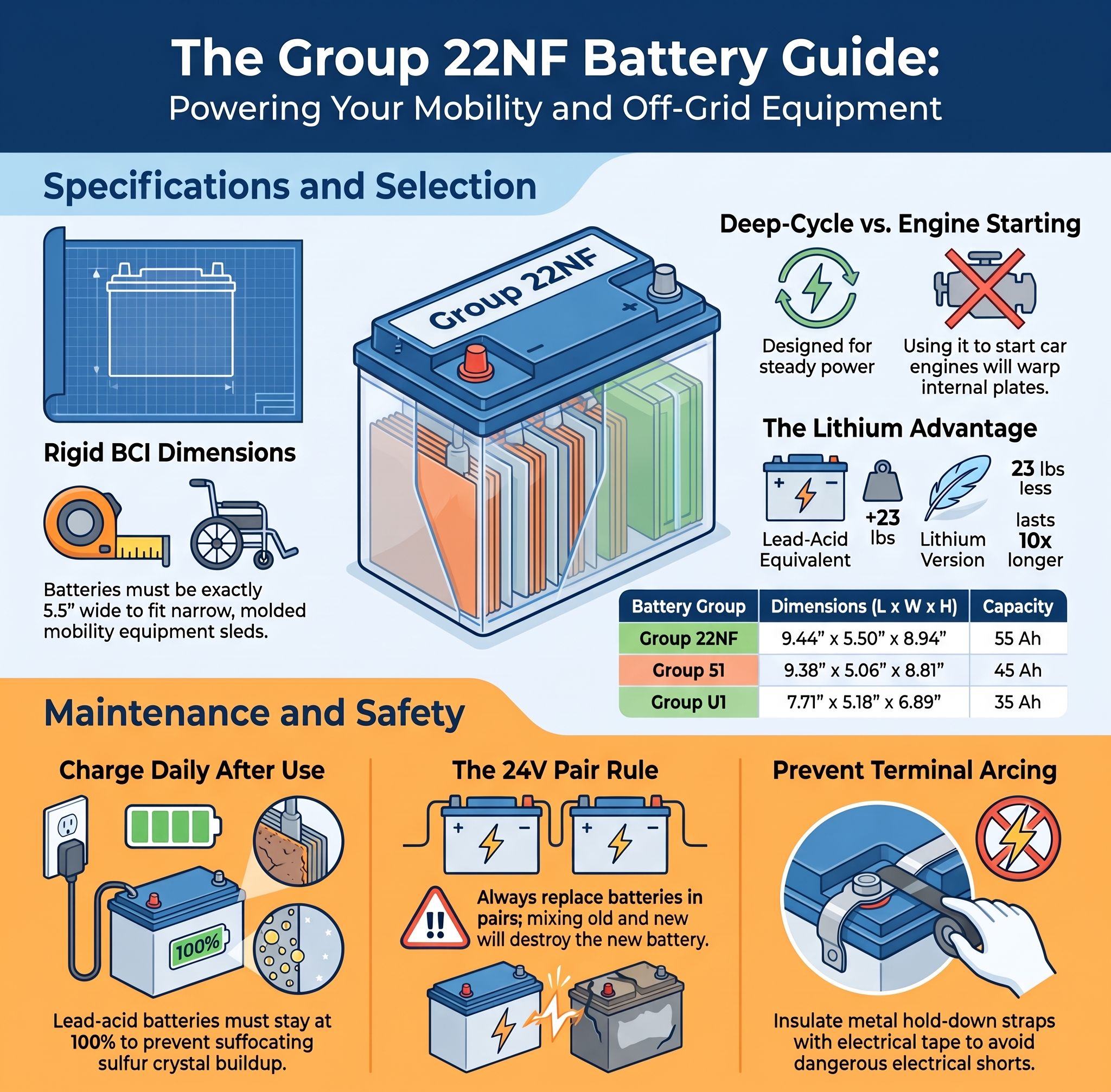
Understanding the exact physical and electrical boundaries of your power source is non-negotiable. The Battery Council International (BCI) classifies the 22NF specifically to guarantee a standardized fit in notably narrow enclosures. If a battery is off by even a fraction of an inch, it simply won’t slide into the molded plastic battery sleds used by most mobility and medical equipment manufacturers.
| Specification | Measurement / Technical Detail |
|---|---|
| Dimensions (L x W x H) | 9.44″ x 5.50″ x 8.94″ (240 x 140 x 227 mm) |
| Voltage | 12 Volts |
| Typical Capacity (Ah) | 55 Ah (Amp-Hours) at a 20-hour discharge rate |
| Reserve Capacity (RC) | Approx. 90 to 100 minutes @ 25 Amps |
| Terminal Type | NB (Nut and Bolt Flag), Internal Thread, or Type A (Top Post) |
| Average Weight | 38 – 42 lbs (Lead-Acid) / 15 lbs (Lithium) |
The defining characteristic of these specifications is the strict 5.5-inch width limit paired with a high 55 Ah capacity. Achieving this electrical density in such a slim profile requires thick, heavy lead plates. This is why a genuine lead-acid 22NF is deceptively heavy. The Reserve Capacity (RC) rating of roughly 100 minutes means that even under a heavy 25-amp load, this battery will keep pushing power for over an hour and a half before going completely flat. This endurance is the hallmark of a true deep-cycle unit.
Ideal Applications: What It Is For (And What It Is Not For)
Batteries are tools, and using the wrong tool for the job is a recipe for disaster. The 22NF is specifically engineered to provide a steady, moderate amount of power over a long period of time, rather than a massive, instantaneous burst of energy.
- Perfect For (Deep-Cycle Use): Power wheelchairs, heavy-duty mobility scooters, off-grid solar energy storage, marine trolling motors, RV house power, and industrial floor scrubbers. These machines sip power constantly and drain the battery deeply before recharging.
- Terrible For (Engine Starting): Do not use a 22NF as the primary starting battery for a standard gasoline or diesel car engine. It lacks the high Cold Cranking Amps (CCA) required to turn over a heavy engine block. While it might work in an emergency, the massive amp-draw of a car starter will physically warp the thick plates inside a deep-cycle battery, destroying its lifespan.
Comparison with Alternative Group Sizes
Finding a true 22NF on the shelf of a local auto parts store can sometimes feel like hunting for a unicorn. If you are stranded, you might have to look at neighboring BCI sizes. However, swapping sizes means performing a delicate balancing act between physical dimensions and electrical capacity. Go too small, and you severely handicap your driving range; go too big, and you will be trying to force a square peg into a round hole.
| Battery Group | Dimensions (L x W x H) | Typical Capacity | Fitment & Viability Notes |
|---|---|---|---|
| Group 22NF (Original) | 9.44″ x 5.50″ x 8.94″ | 55 Ah | The gold standard. Perfect balance of narrow size and long driving range. |
| Group 51 (Smaller Alternative) | 9.38″ x 5.06″ x 8.81″ | 45 Ah | Drops perfectly into a 22NF tray with room to spare. Crucial: You must ensure you buy a deep-cycle variant, not a standard car starter battery. |
| Group U1 (Budget/Compact) | 7.71″ x 5.18″ x 6.89″ | 35 Ah | Fits easily. Common for small wheelchairs, but the drastically lower capacity means your operational range will be cut by nearly 40%. |
| Group 24 (Larger Upgrade) | 10.25″ x 6.81″ x 8.88″ | 75 Ah | Massive capacity upgrade, but at 6.81 inches wide, it will NOT fit in a strict 22NF tray without custom, potentially dangerous modifications to the chassis. |
Upgrading Chemistry: AGM vs. GEL vs. Lithium
Modern 22NF batteries used in enclosed spaces are sealed and spill-proof. But the chemistry hiding inside that plastic box dictates how far you can drive, how long it takes to charge, and how soon you’ll have to buy a replacement.
- AGM (Absorbent Glass Mat): The reliable middle ground. AGM uses fiberglass mats to hold the electrolyte, making them incredibly resistant to the bone-rattling vibrations of a riding lawnmower. They are affordable, powerful, and completely maintenance-free.
- GEL Cell: The slow-and-steady marathon runners. The acid is mixed with silica to form a thick paste. GEL batteries hate being charged quickly, but they excel at slow, incredibly deep discharges and high heat. If you are using your 22NF for a solar gate opener in the scorching sun, GEL is a fantastic choice.
- LiFePO4 (Lithium Iron Phosphate): The holy grail. A lithium 22NF will make your wallet cry upfront (often costing 3 times as much as AGM), but a lead-acid 22NF weighs around 38 lbs, while a Lithium equivalent weighs just 15 lbs. For a mobility scooter carrying two of these, you shed 45 pounds of dead weight! Plus, Lithium batteries can handle up to 3,000 charge cycles compared to AGM’s 300.
Replacement Guide and The 24V Trap
Swapping a 22NF battery requires a wrench and a healthy dose of common sense. Because these batteries are tall (nearly 9 inches), the metal terminals sit dangerously close to the bottom of whatever metal seat covers the battery compartment. Before you connect the red and black wires, check your equipment’s hold-down brackets. If you have an uninsulated metal strap locking the battery in place, wrap it generously in electrical tape to prevent accidental arcing.
The 24V Warning: If you are driving a power wheelchair, you are likely running two 22NF batteries wired together in a series to create a 24-volt system. If one battery dies, never replace just one. Wiring a brand-new battery to a degraded, old battery is like forcing an Olympic sprinter to run a three-legged race with an 80-year-old. The smart battery charger will sense the total voltage, realize the old battery is lagging, and keep pumping electricity into the system. This will literally boil and overcharge your brand-new battery, destroying it in months. Always replace 24V setups in pairs. No exceptions.
Storage, Charging, and Maintenance Best Practices
Buying a great battery is only half the battle; keeping it alive requires discipline. The number one killer of lead-acid (AGM and GEL) batteries is sulfation. When a battery is left in a partially discharged state for days or weeks, hard sulfur crystals form on the lead plates, permanently suffocating its ability to hold a charge.
- Charge Daily: If you use your mobility scooter for 15 minutes or 5 hours, plug it in when you get home. Lead-acid batteries love to be kept at 100% capacity.
- Winter Storage: If you are putting your equipment away for the winter, fully charge the battery first, then disconnect the negative terminal so the equipment’s internal computers don’t slowly drain it.
- Use a Smart Charger: Never use a cheap, old-school automotive trickle charger that pushes constant voltage indefinitely. Use a multi-stage “Smart Charger” (like a NOCO or Battery Tender) that automatically drops to a float mode once the battery is full, preventing it from boiling dry.
Frequently Asked Questions (FAQ)
Can I safely lay a 22NF battery on its side?
If it is a modern, sealed AGM or GEL battery, yes, you technically can mount it on its side, as there is no liquid acid to spill. However, you must never mount it upside down. If it is a traditional flooded lead-acid battery with removable caps, it must absolutely remain upright at all times to prevent highly corrosive acid from leaking out and destroying your equipment.
Why does my new mobility scooter battery die so quickly?
AGM and GEL batteries require a “break-in” period. When they are brand new from the factory, they only operate at about 75-80% of their peak capacity. It takes roughly 15 to 20 cycles of discharging and fully recharging before the chemicals inside fully activate and reach their maximum run time.
Is the Lithium upgrade actually worth it?
If you rely on your equipment daily as your primary mode of transportation, 100% yes. Not only does the massive weight reduction give your electric motor a break, but lithium batteries provide a completely flat voltage curve. With an AGM battery, your scooter will feel sluggish and slow when the battery hits 30%. With Lithium, the scooter will drive at full speed right up until the exact moment it needs a recharge.
Final Verdict: Securing Your Peace of Mind
Dealing with dead deep-cycle batteries is a headache, but upgrading your Group 22NF setup doesn’t have to be a blind guessing game. If you are strapped for cash and just want your equipment back in action, a pair of high-quality AGM batteries will easily give you a few years of reliable service provided you charge them daily. But if you are tired of range anxiety and have the budget to invest in the future, pulling the trigger on a LiFePO4 lithium upgrade is a game-changer that will literally take a weight off your shoulders. Measure your tray, double-check your terminal connections, always replace them in pairs, and get back out there with confidence!

Eric Strong works in the automotive repair industry more than 20 years. His work included repairing electrical systems in various vehicle systems. A hybrid electric car battery replacement experience expanded his understanding of automotive battery technology.
Page Contents