Are you confused about the differences between Group 48 (H6) and Group 49 (H8) batteries? You’re not alone. In the world of modern automotive engineering, particularly for European and high-end domestic vehicles, these two sizes are the dominant standards. Choosing the right battery can feel overwhelming because they look remarkably similar, but the right choice affects how long your car runs, how reliable your electronics stay, and your overall peace of mind.
In this comprehensive guide, we will break down the physical dimensions, power metrics, and the critical “hidden” requirement of ECU registration. By the end, you’ll discover the key differences between these two battery groups, helping you make a smart decision that fits your vehicle’s needs perfectly. Keep reading, and you’ll never second-guess your battery choice again.
Group 48 (H6) Basics: The Versatile Standard
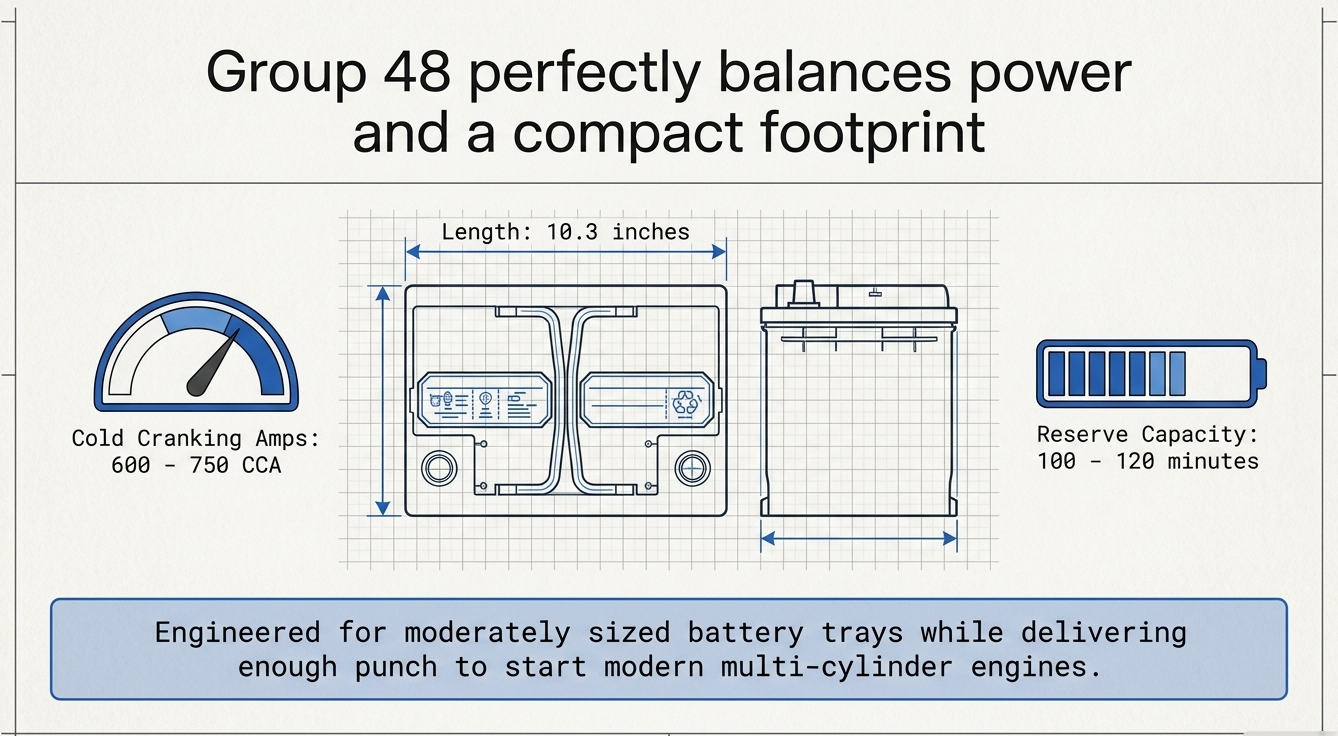
Group 48 (H6) batteries are known for their exceptional balance of power and compact size. They are the go-to choice for a vast array of mid-sized sedans and crossovers. Understanding their fundamentals helps you realize why they are so prevalent in the industry.
Key Features of Group 48
The Group 48 battery is engineered to fit into moderately sized battery trays while delivering enough “punch” to start modern multi-cylinder engines. Their construction often features maintenance-free, sealed technology designed to resist the high heat found in modern engine bays.
| Feature | Specification (Typical) |
|---|---|
| Voltage | 12 Volts |
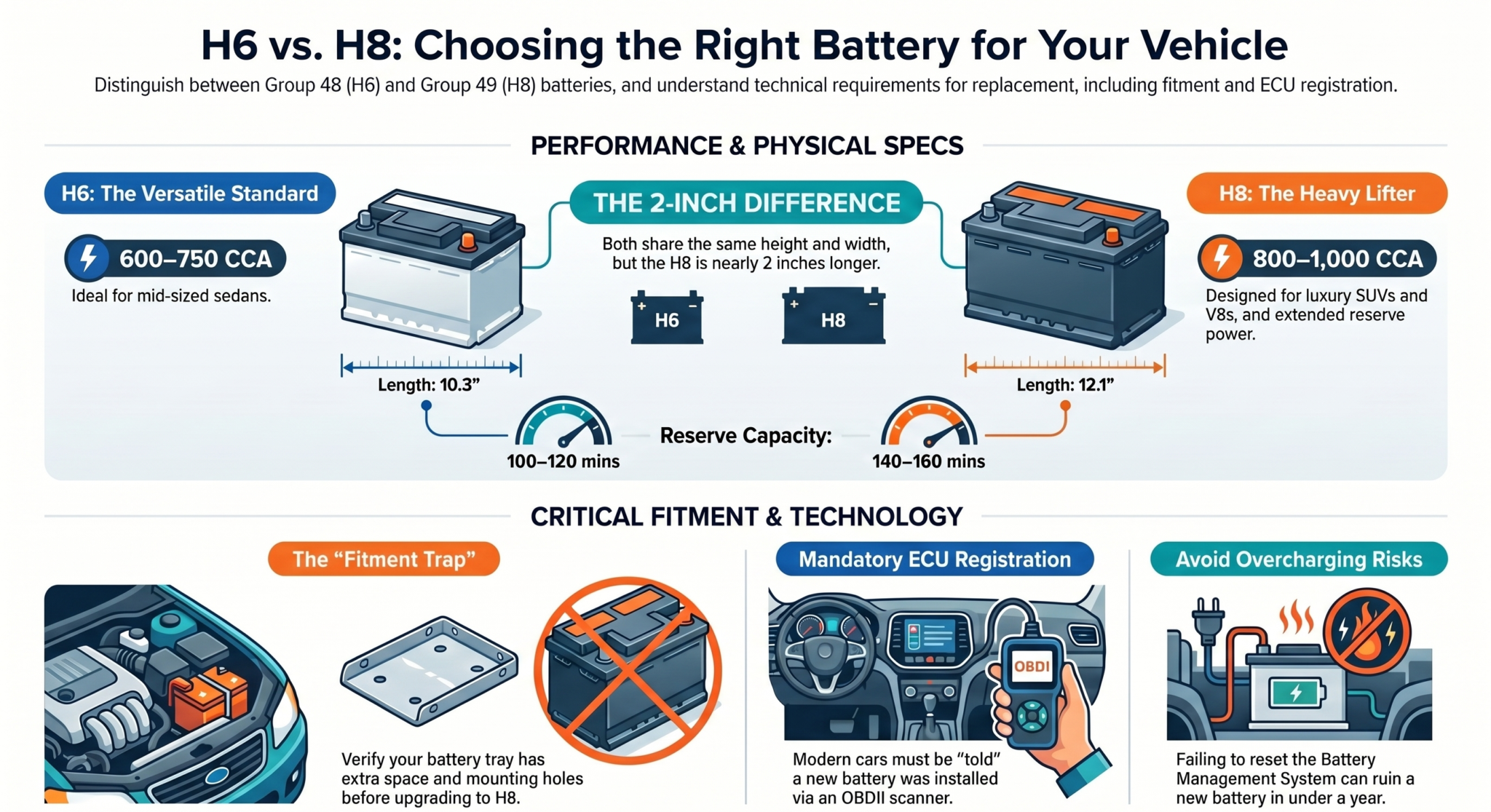
| Cold Cranking Amps (CCA) | 600 – 750 CCA |
| Reserve Capacity (RC) | 100 – 120 minutes |
| Dimensions (L x W x H) | 10.3″ x 6.8″ x 7.5″ |
Typical Applications
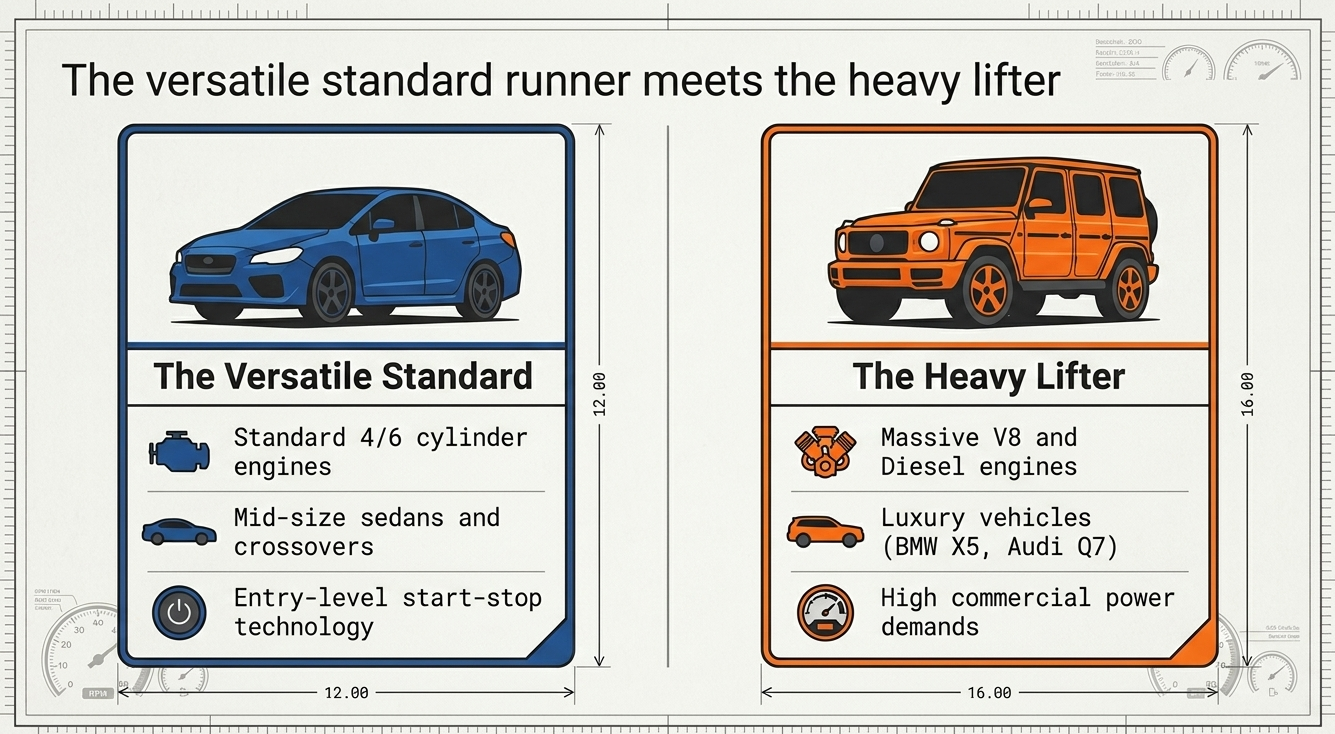
Group 48 batteries serve a wide range of vehicles. You will commonly find them in mid-sized sedans like the Honda Accord or Toyota Camry (in certain regions), as well as many BMW 3-series and Audi A4 models. They also support vehicles with entry-level start-stop technology, providing reliable power for frequent restarts during city driving.
Group 49 (H8) Essentials: The High-Capacity Choice
Group 49, also known as H8, is the larger, more robust sibling. It is designed for vehicles that demand massive energy reserves and higher cranking power. If the Group 48 is the “standard” runner, the Group 49 is the “heavy lifter.”
Core Characteristics of H8
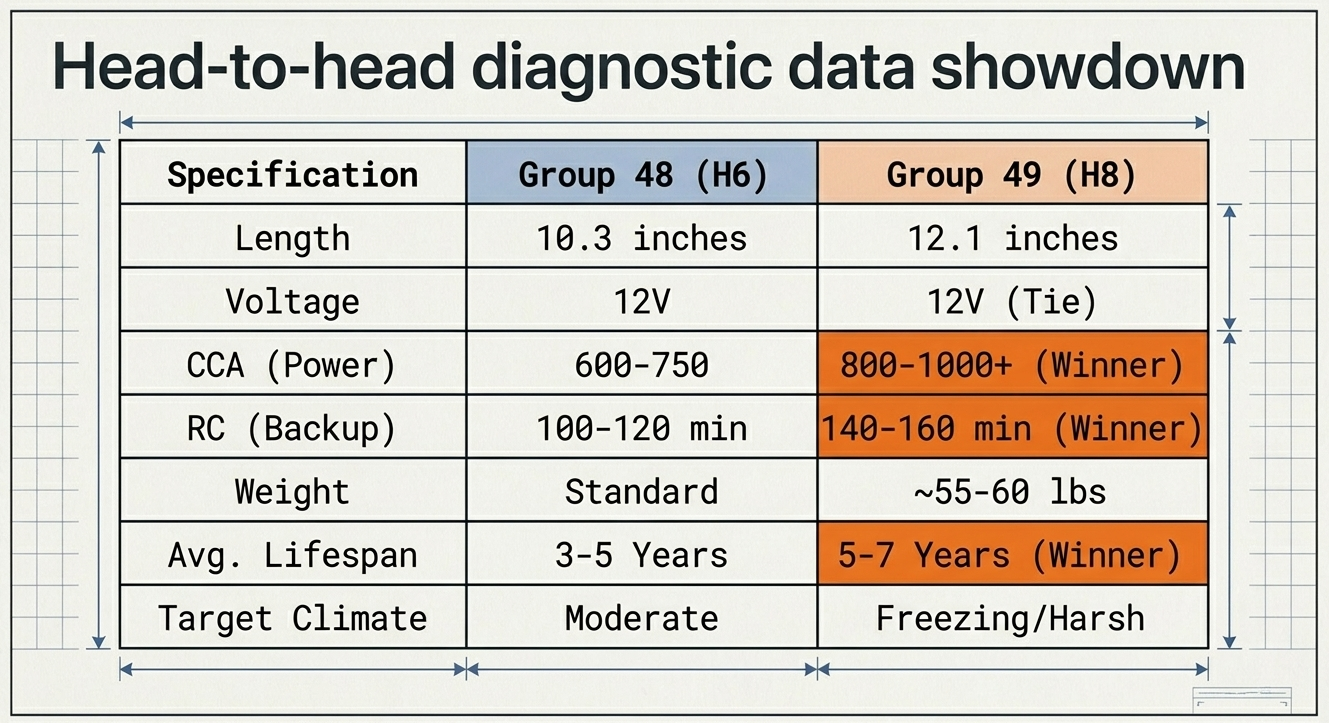
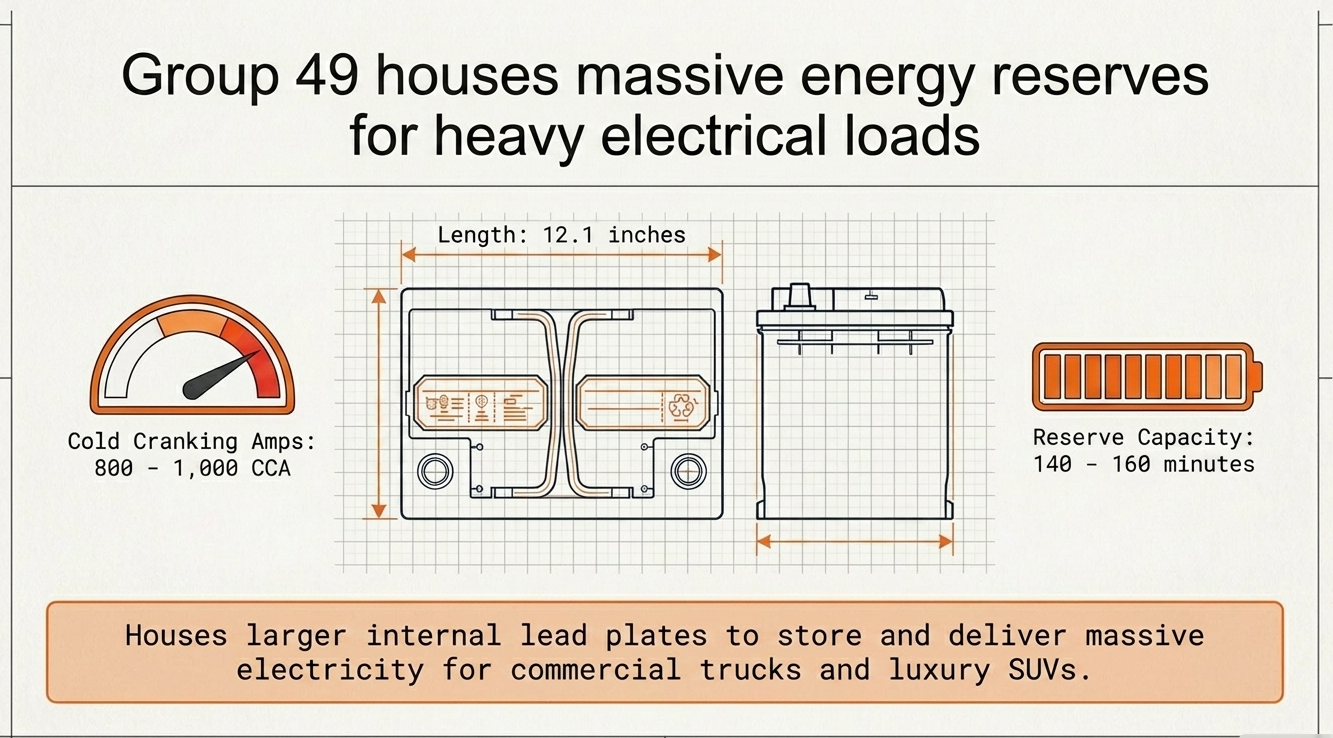
The primary advantage of the H8 size is its length. At approximately 12.1 inches long, it has more internal volume to house larger lead plates, which directly increases its capacity to store and deliver electricity.
- High Power Output: Typically delivering between 800 and 1,000 CCA.
- Extended Reserve: Offers 140 to 160 minutes of backup power.
- Heavy-Duty Build: Designed to withstand the electrical stress of luxury SUVs (like the BMW X5 or Audi Q7) and commercial-grade trucks.
Physical Comparison: Size and Dimensions
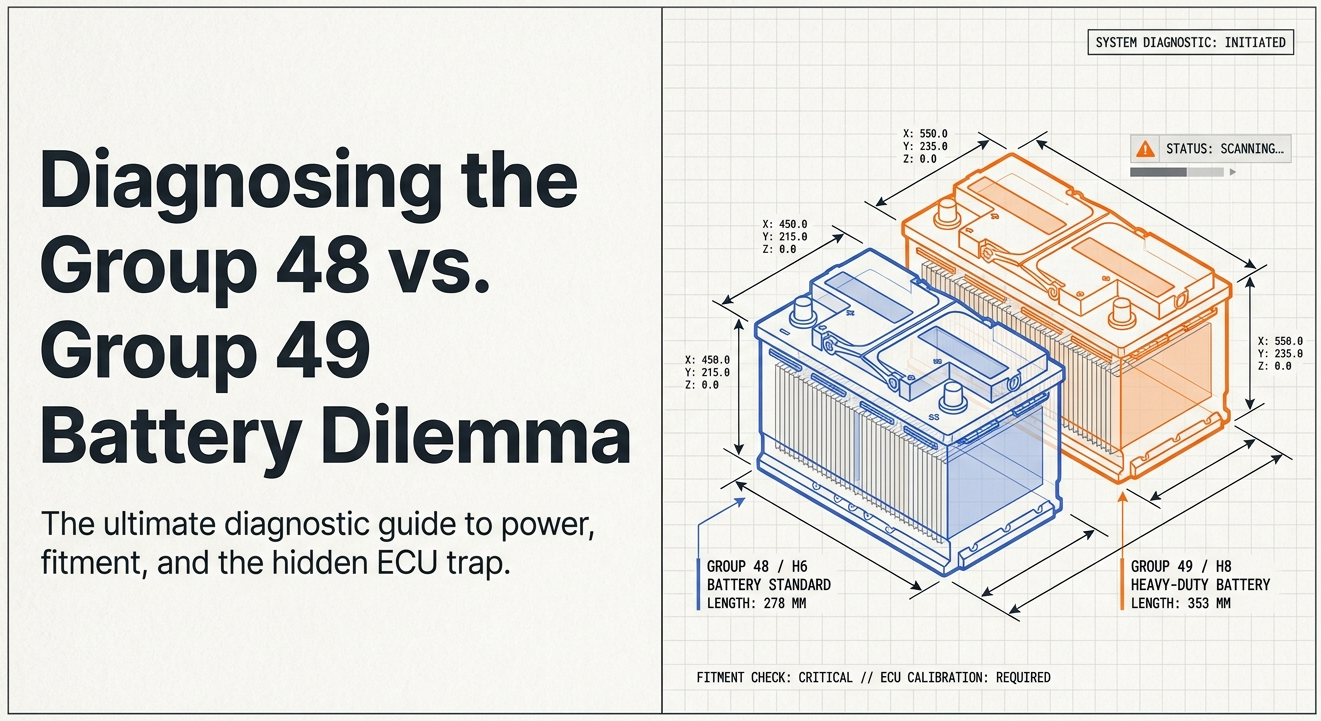
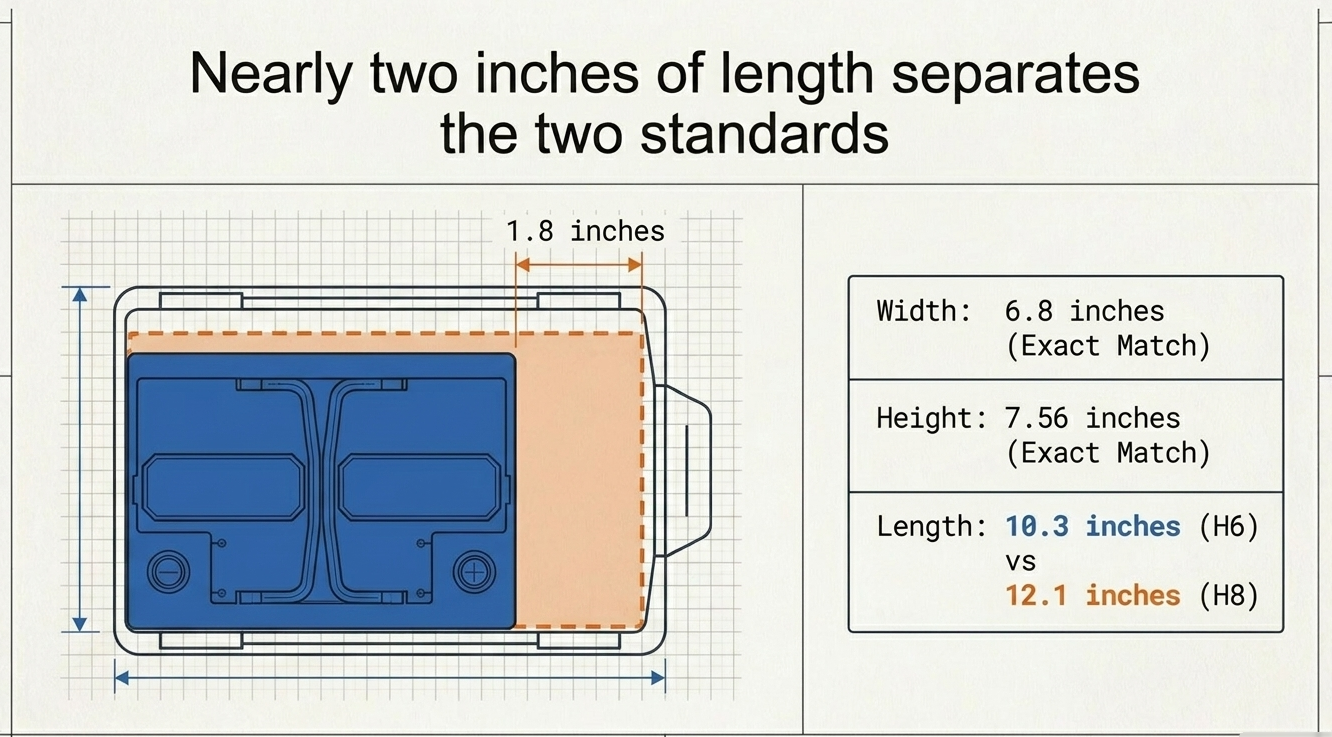
The most critical fitment factor is the physical footprint. While both batteries share the same height and width, the H8 is nearly 2 inches longer than the H6.
| Battery Group | Length | Width | Height |
|---|---|---|---|
| Group 48 (H6) | 10.25 – 10.3″ | 6.81″ | 7.56″ |
| Group 49 (H8) | 12.06 – 12.1″ | 6.88″ | 7.56″ |
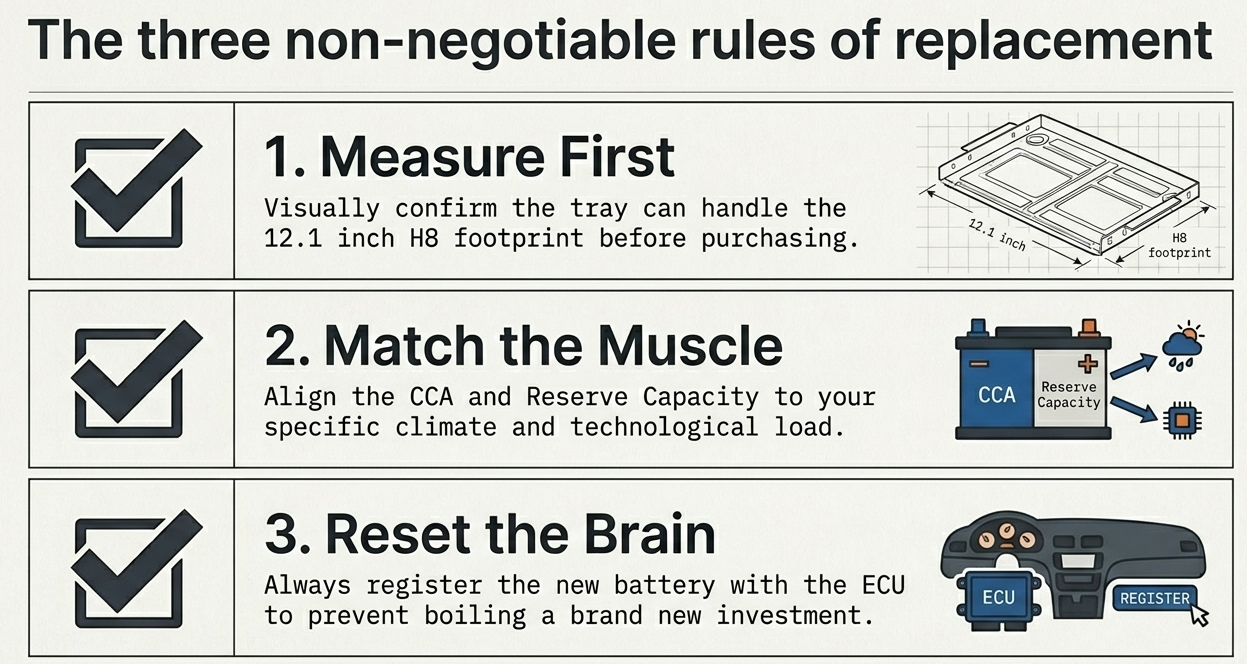
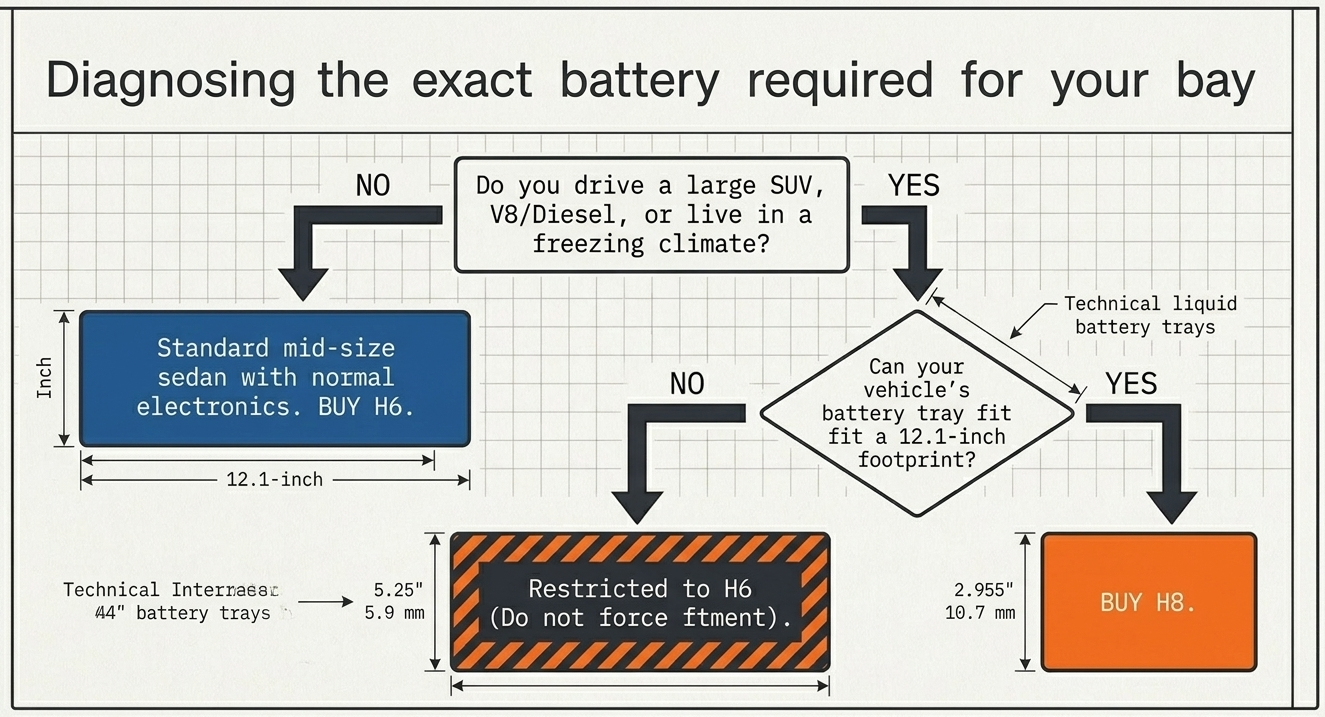
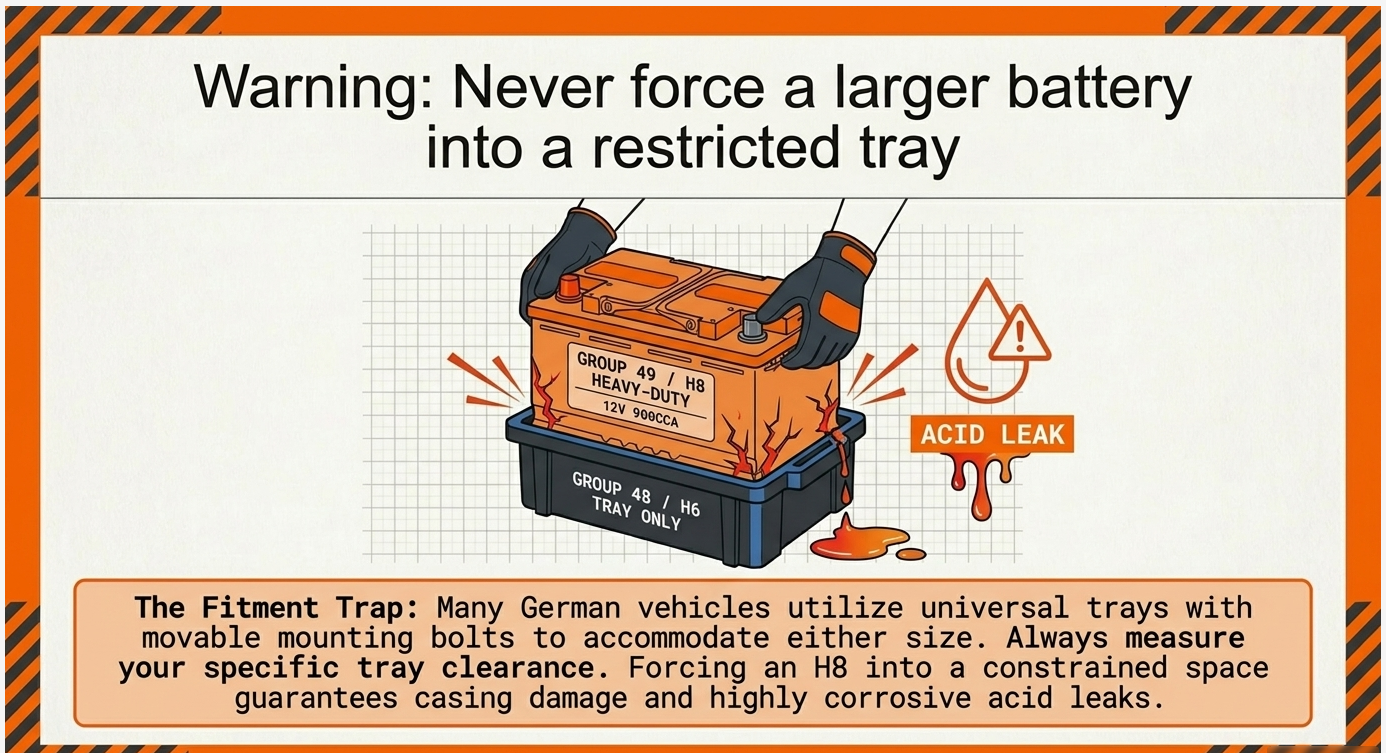
The “Fitment Trap”: Many German vehicles have universal trays that can fit either size by moving a mounting bolt. However, never assume your car can take the larger H8 without checking. If the tray is too small, forcing the battery in can damage the casing and lead to acid leaks.
Power and Capacity: Understanding CCA and RC
Power and capacity affect how well your vehicle starts and how long the battery can run accessories without the engine running.
Defining CCA for a Child:
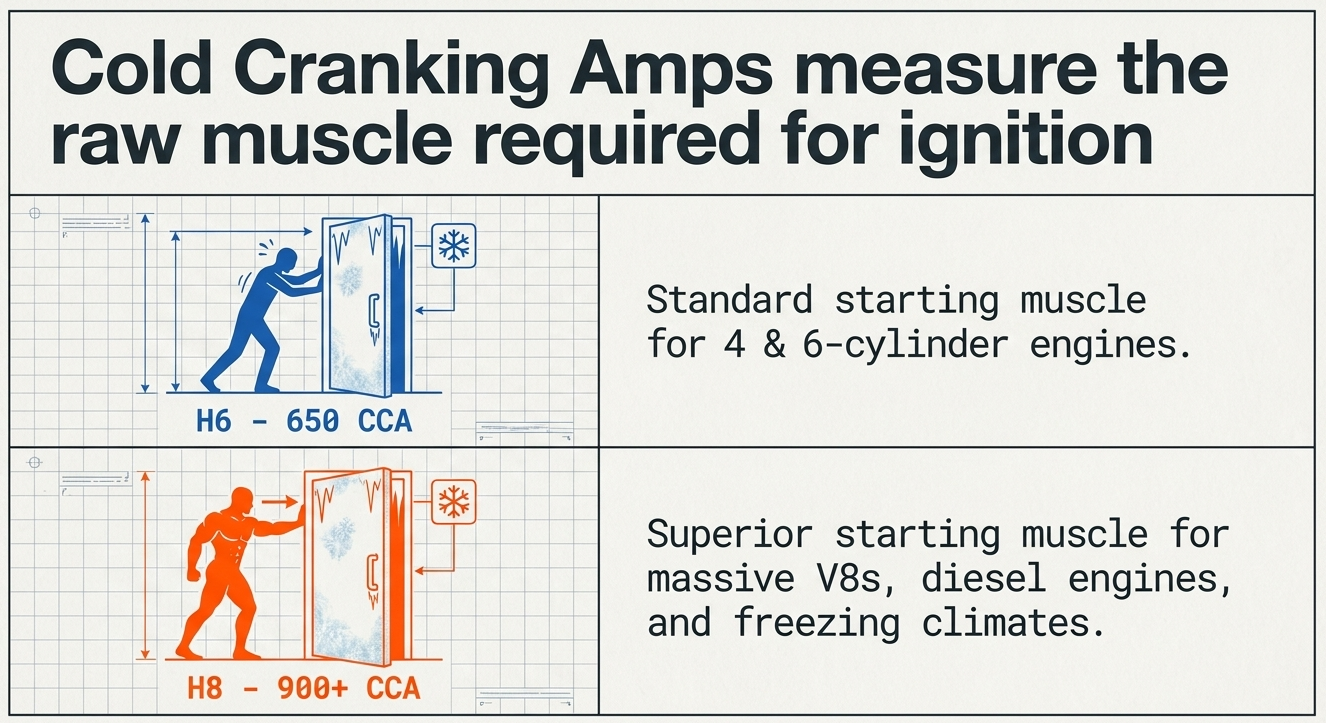
Imagine your car engine is a heavy door you need to push open. Cold Cranking Amps (CCA) is how much “muscle” the battery has to push that door open on a freezing cold morning. The Group 49 (H8) simply has more muscles than the Group 48 (H6).
- Cold Cranking Amps (CCA): H8 batteries (800-900+) are superior for large diesel engines or V8s. H6 batteries (650-750) are perfect for standard 4 and 6-cylinder engines.
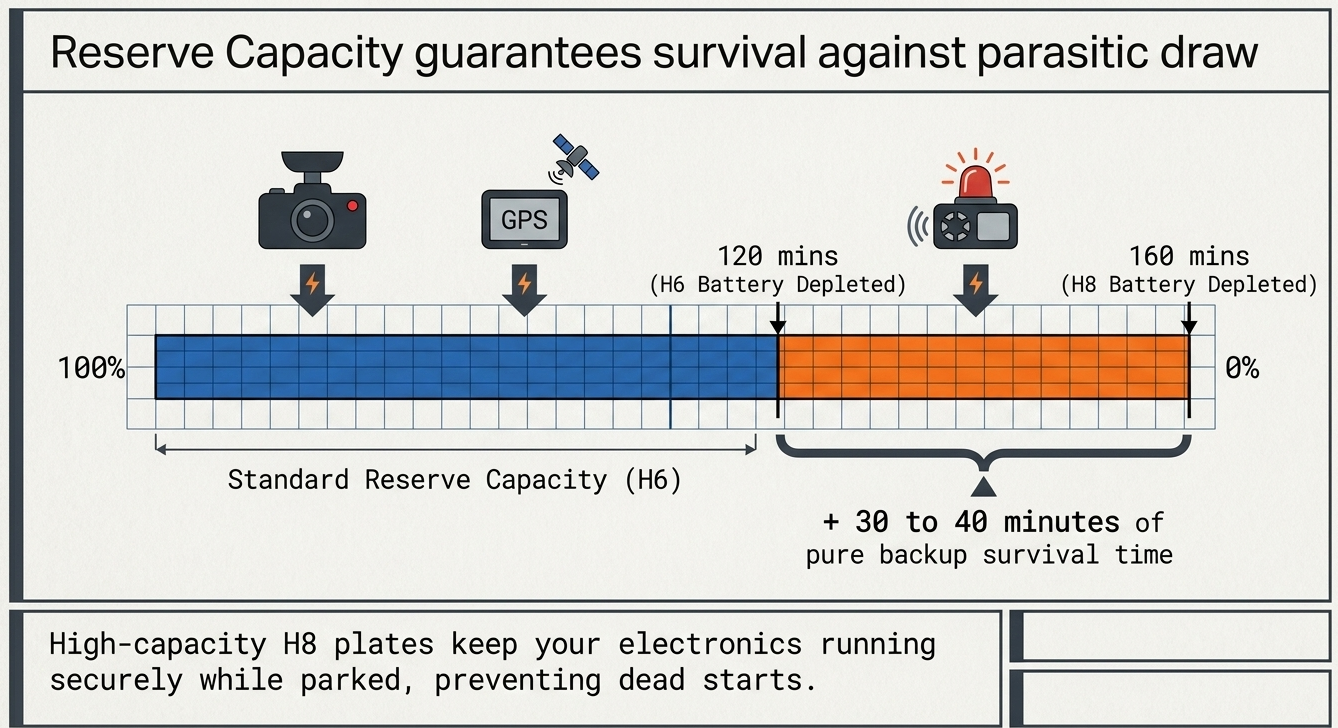
- Reserve Capacity (RC): The H8 gives you an extra 30-40 minutes of power. This is crucial if you have a high “parasitic draw” from car alarms, GPS, and dashcams that stay active while parked.
The Critical Step: ECU Registration and BMS Reset
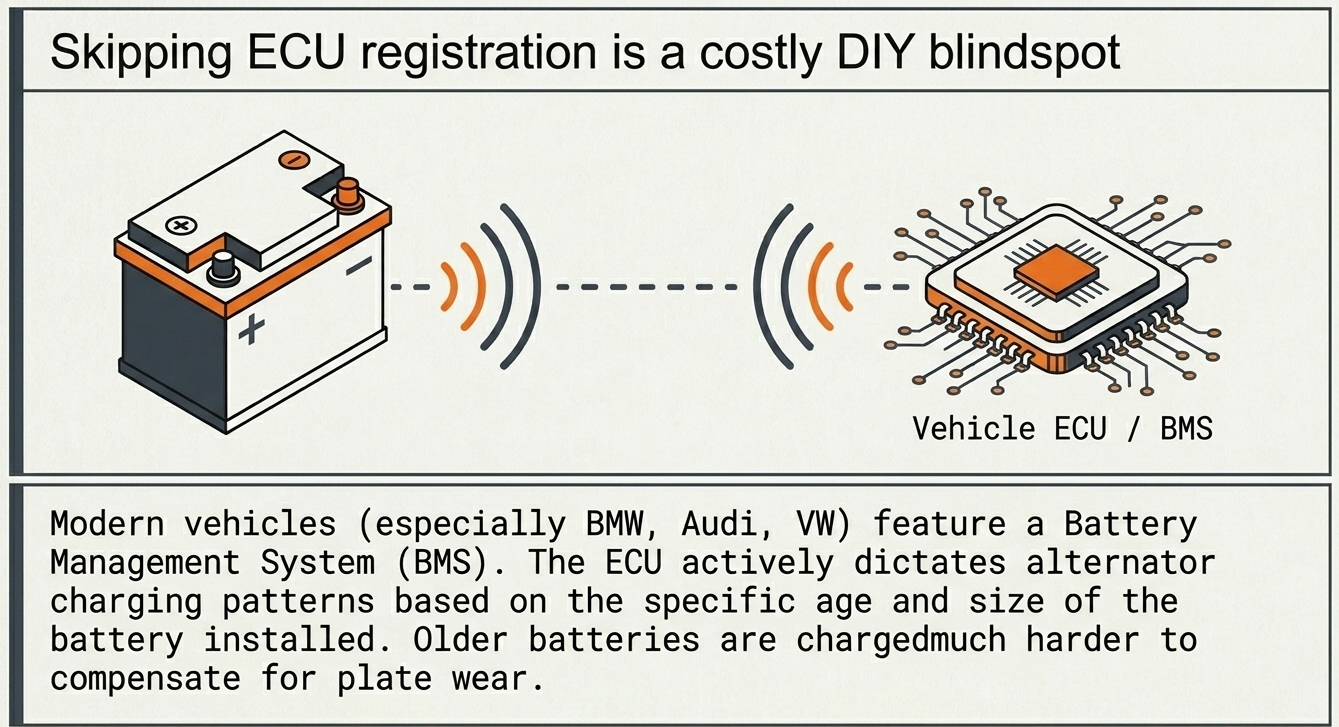
This is a technical point that many DIY owners miss. Modern vehicles—especially from BMW, Audi, and VW—use a Battery Management System (BMS). This system is part of the car’s computer (ECU) and it controls how the alternator charges the battery.
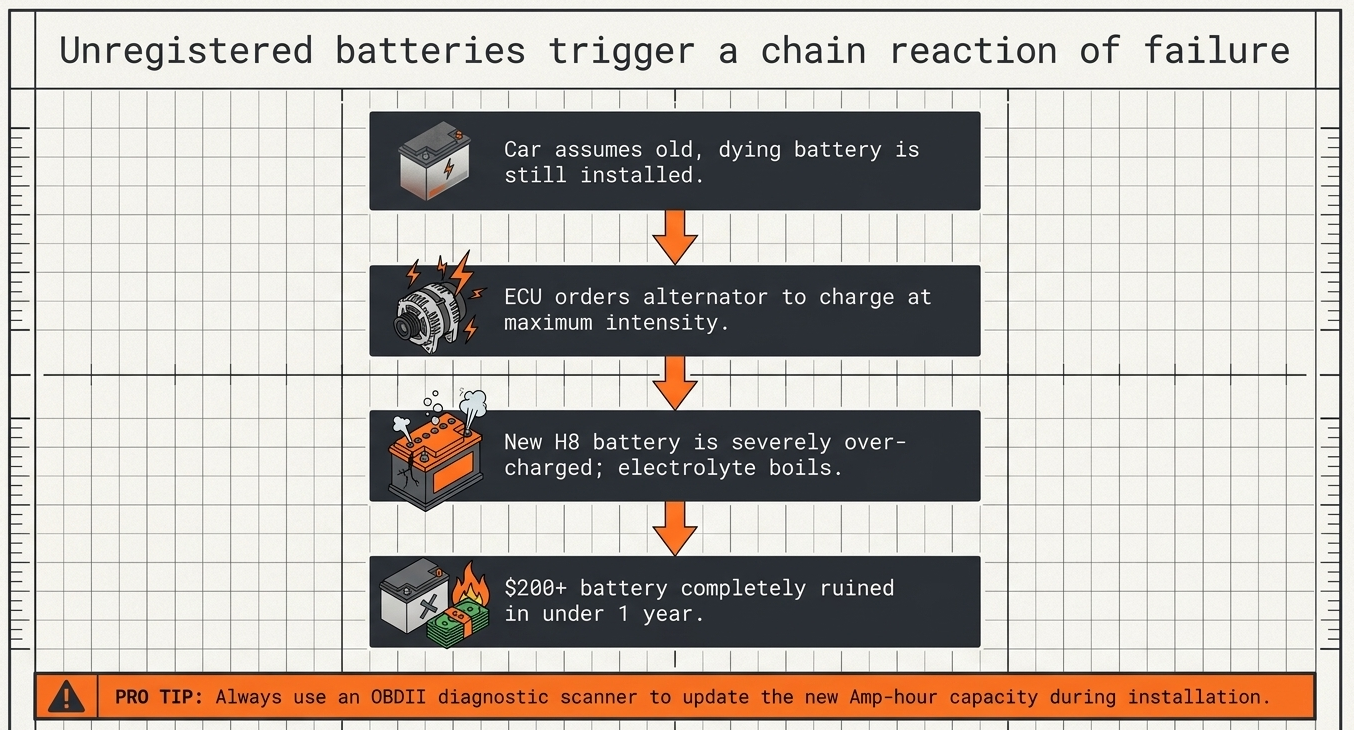
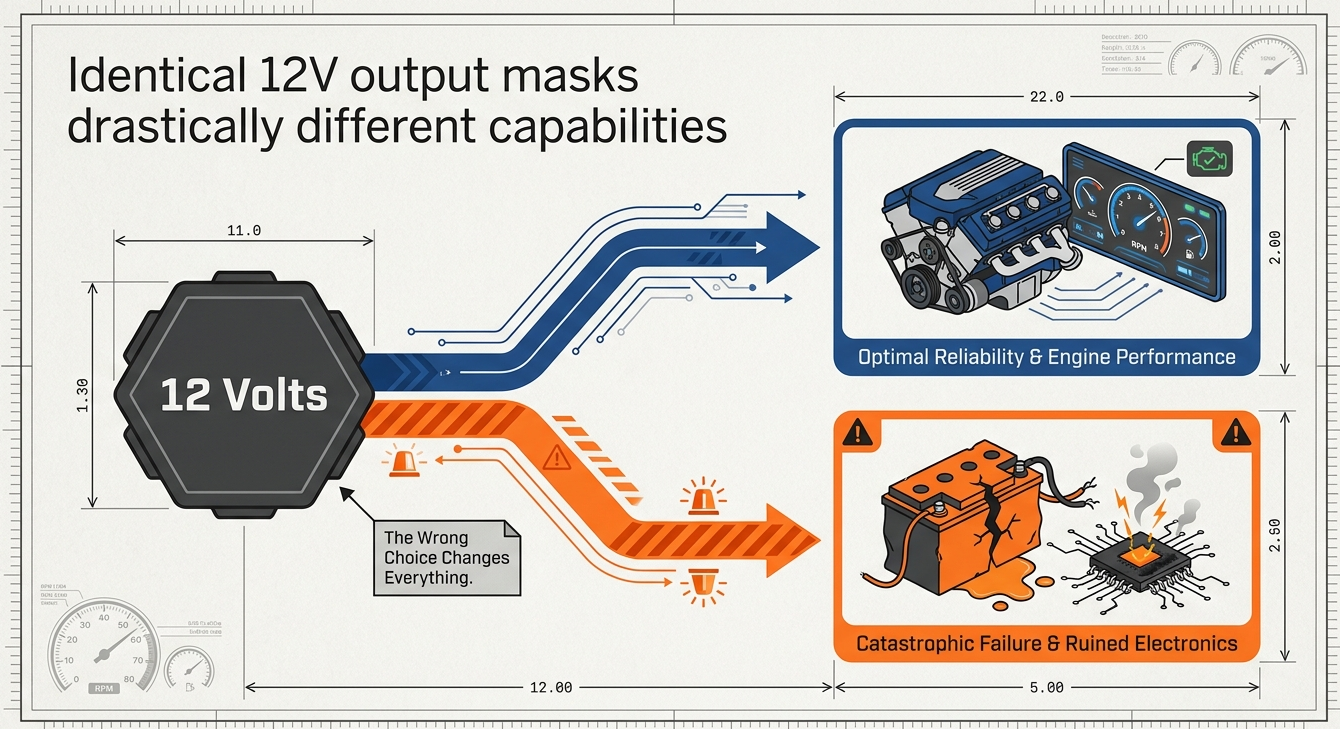
As a battery gets older, the ECU tells the alternator to charge it harder to compensate for wear. If you install a new Group 49 (H8) battery without “registering” it or resetting the ECU:
- The car will think the old, worn-out battery is still there.
- It will overcharge the new battery, potentially boiling the electrolyte.
- Your new $200 battery could be ruined in less than a year.
Professional Tip: Always use a diagnostic tool (like an OBDII scanner) to register a new battery, especially when switching sizes from an H6 to an H8. The car needs to know the new capacity (Amp-hours) to adjust the charging profile correctly.
Maintenance and Durability Comparison
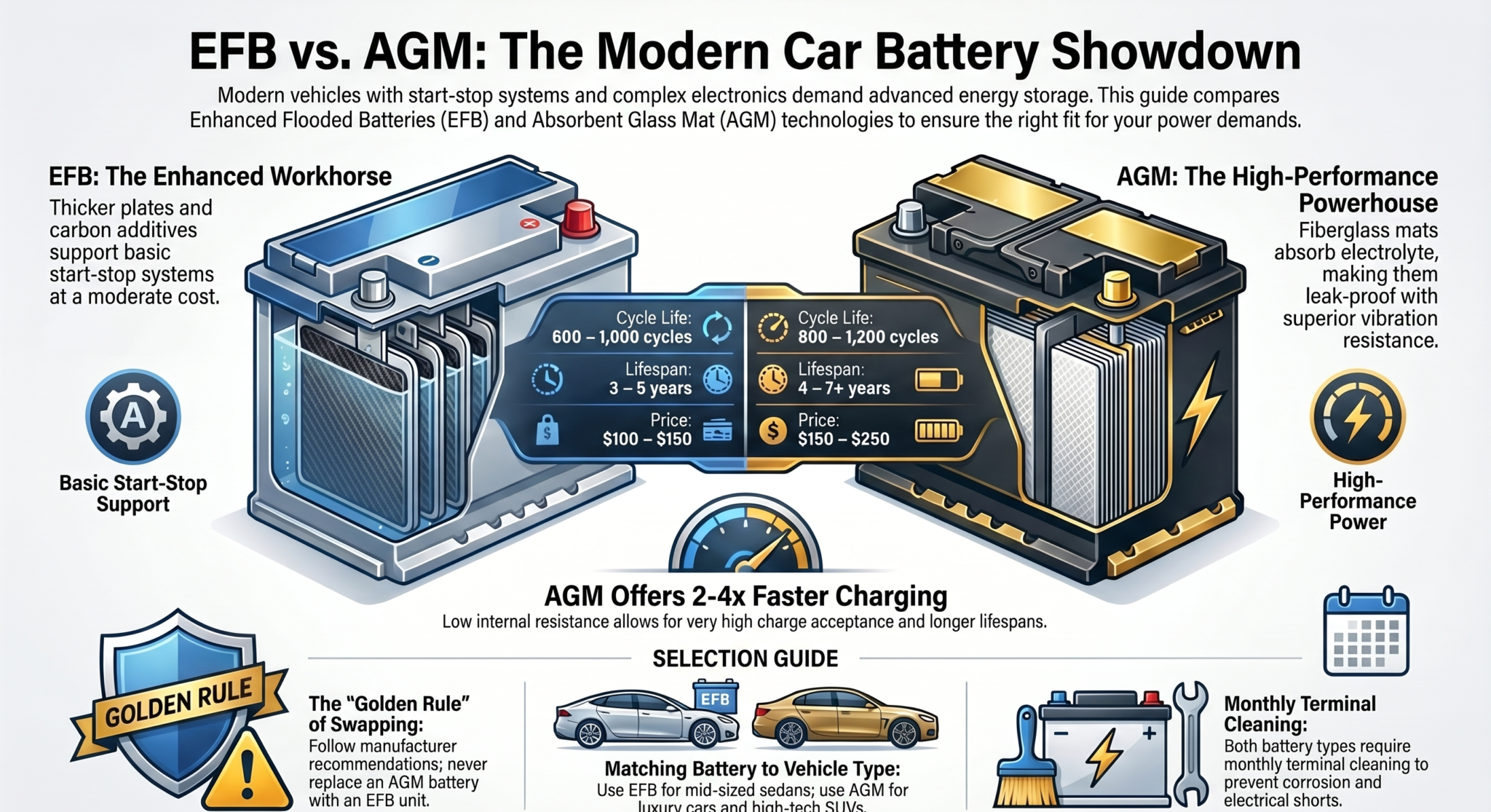
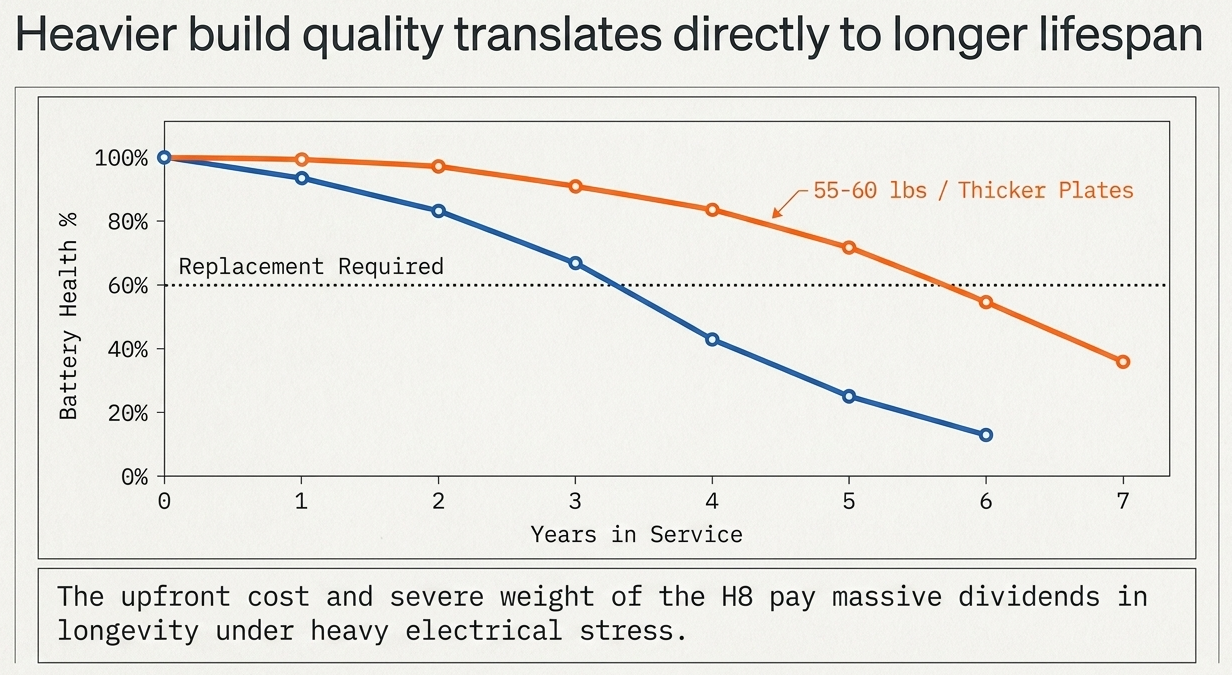
Both battery groups are typically found in AGM (Absorbent Glass Mat) or high-quality flooded versions. While the Group 49 (H8) is physically heavier (often 55-60 lbs), its robust build usually allows it to handle more charge cycles. A well-maintained H8 can last 5-7 years, while an H6 typically averages 3-5 years under similar stress.
Frequently Asked Questions
What are the main differences between Group 48 (H6) and Group 49 (H8)?
The primary difference is size and capacity. The H8 is longer and offers higher Cold Cranking Amps (800+) and more Reserve Capacity than the compact H6.
Can I replace my H6 battery with an H8?
Only if your vehicle’s battery tray has the extra 2 inches of space and a mounting hole for the longer size. You must also register the new size in the vehicle’s computer (ECU) to ensure proper charging.
Which battery is better for cold weather?
The Group 49 (H8) is superior for cold weather because its higher CCA rating ensures there is enough current to turn over a cold, stiff engine.
Final Verdict: Matching the Power to Your Needs
Group 48 (H6) and Group 49 (H8) each have unique strengths. Choosing depends on your vehicle’s tray size and your power demands. If you have a luxury SUV with many electronics or live in a freezing climate, the extra investment in a Group 49 (H8) provides a significant safety margin. For standard mid-sized cars, the Group 48 (H6) remains the perfect, lightweight, and cost-effective standard. Always check your manual, measure your tray, and remember to register your new battery with your car’s computer to ensure a long and reliable life.

Eric Strong works in the automotive repair industry more than 20 years. His work included repairing electrical systems in various vehicle systems. A hybrid electric car battery replacement experience expanded his understanding of automotive battery technology.
Page Contents