Selecting the correct battery for a Toyota Camry requires more than just picking a 12-volt unit off the shelf. To ensure long-term reliability and proper electrical system performance, you must match the physical dimensions and power ratings to the vehicle’s specific engine and model year. For most Camry owners, the primary focus is the Group 24F battery, a standard that defines the tray footprint and terminal orientation.
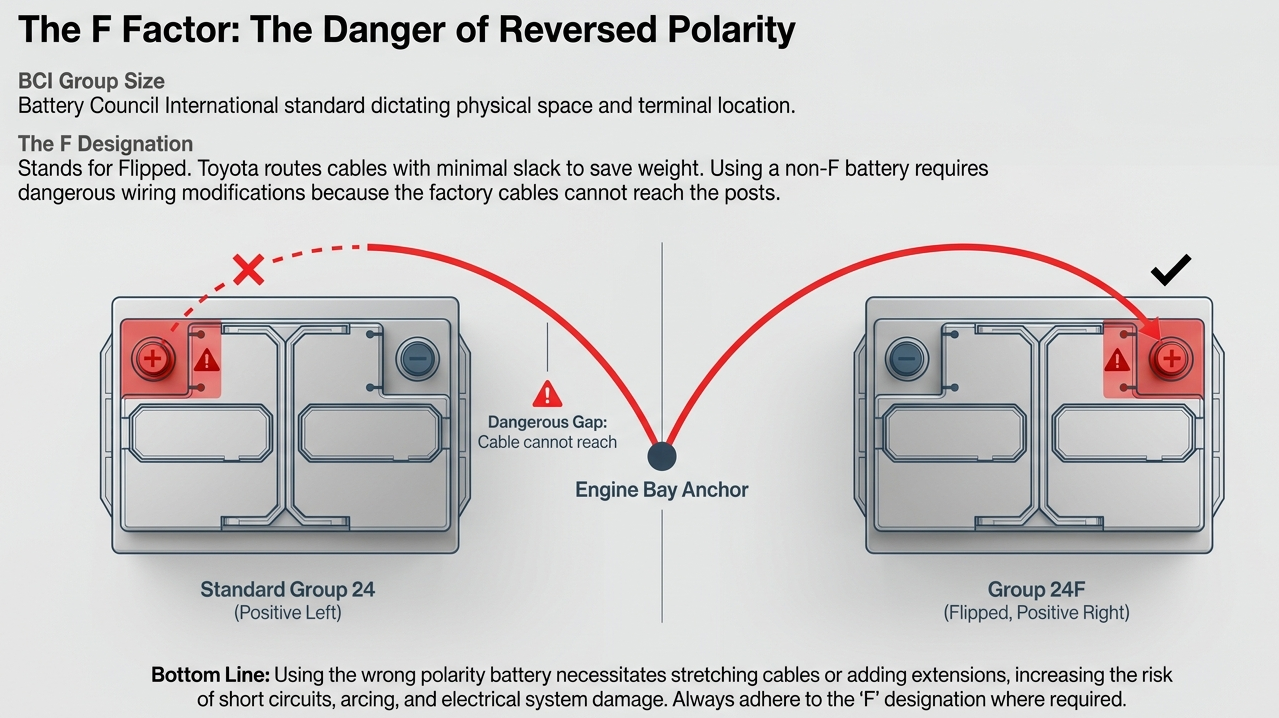
Choosing the wrong size—such as a standard Group 24 instead of a 24F—can lead to reversed polarity issues, where the cables won’t reach the posts. This guide breaks down the technical requirements for every Camry generation to help you make an informed decision without needing to double-check other sources.
The Critical Role of BCI Group Sizes
Understanding the “Group Size” is essential because it is a standard established by the Battery Council International (BCI). It isn’t just a random number; it tells you exactly how much physical space is available in the engine bay and where the positive and negative terminals are located. For a car as precisely engineered as the Camry, using the correct group size ensures the battery is held down securely by the factory brackets, preventing vibration-induced internal damage that can shorten the battery’s life.
Standard Toyota Camry Battery: Group Size 24F
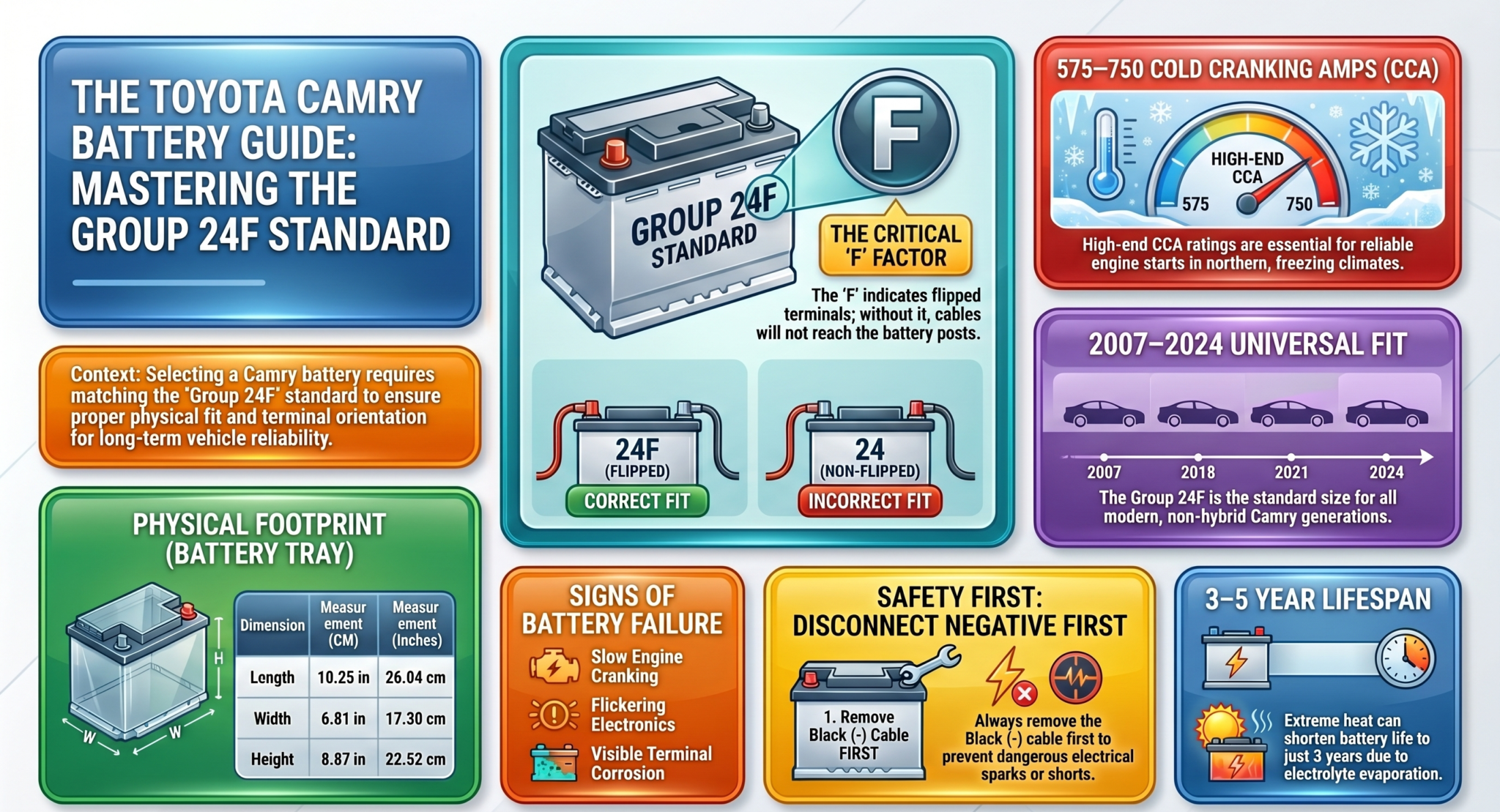
Most Toyota Camry models produced over the last two decades are designed around the Group 24F form factor. The “F” suffix is the most important part of this code—it indicates that the positive terminal is on the right side when facing the battery. Since Toyota routes its battery cables with very little slack to save weight and space, a non-F battery simply will not connect safely without dangerous modifications to the wiring.
| Dimension | Measurement (Inches) | Measurement (CM) |
|---|---|---|
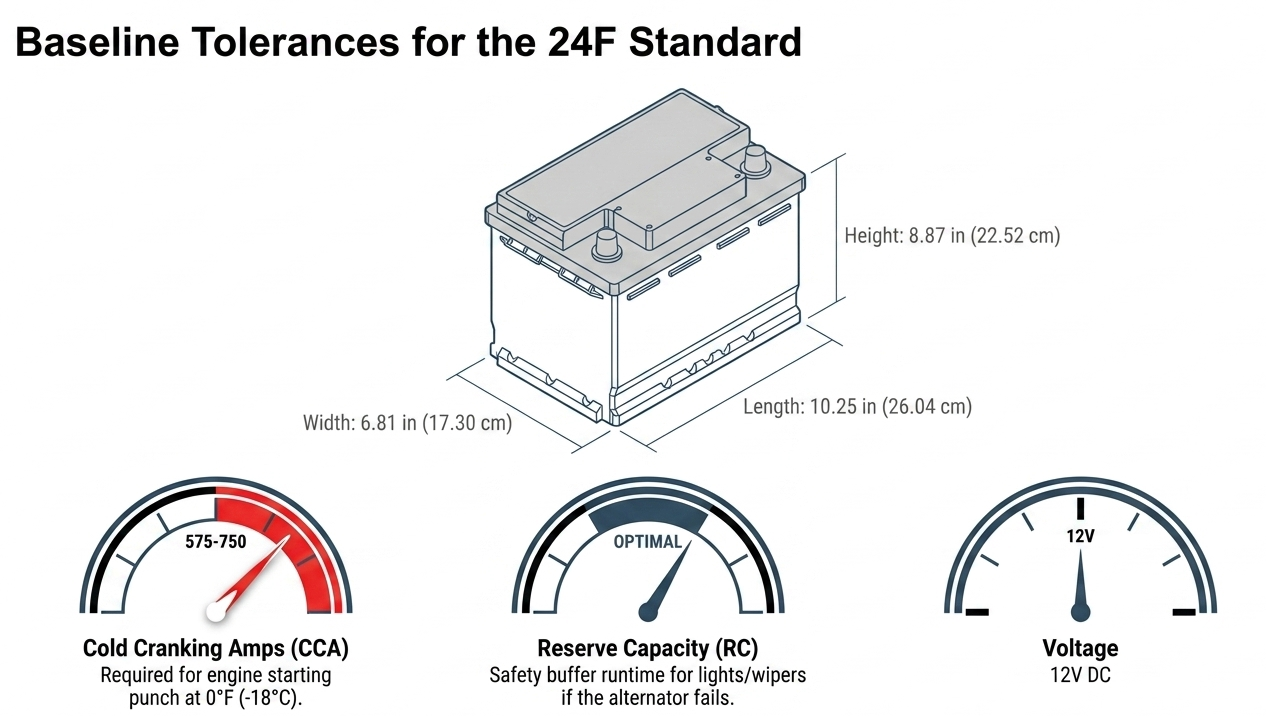
| Length | 10.25 in | 26.04 cm |
| Width | 6.81 in | 17.30 cm |
| Height | 8.87 in | 22.52 cm |
Key Specifications for Camry Owners
Beyond the physical box size, you must verify three specific electrical ratings to ensure your Camry starts reliably in extreme conditions. These metrics determine how the battery will behave during a freezing winter morning or after sitting in a hot parking lot for several days:
- Cold Cranking Amps (CCA): This is the measure of the battery’s ability to start the engine at 0°F (-18°C). A Camry usually requires between 575 and 750 CCA. If you live in a northern climate, aim for the higher end of this range to ensure the starter motor has enough “punch.”
- Reserve Capacity (RC): This rating tells you how many minutes the battery can provide power if the alternator fails. It’s a vital safety buffer that keeps your lights, wipers, and ignition running long enough to pull over safely.
- Voltage: The Camry uses a standard 12-volt DC system. While all car batteries are labeled 12V, the quality of the internal lead plates and the chemistry (AGM vs. Flooded) determine how consistently that voltage is maintained under a heavy electrical load.
Battery Requirements by Model Year
While the 24F is the most common size, the Toyota Camry has a long history, and some older generations or specific powertrain configurations have unique requirements that you need to be aware of before purchasing a replacement:
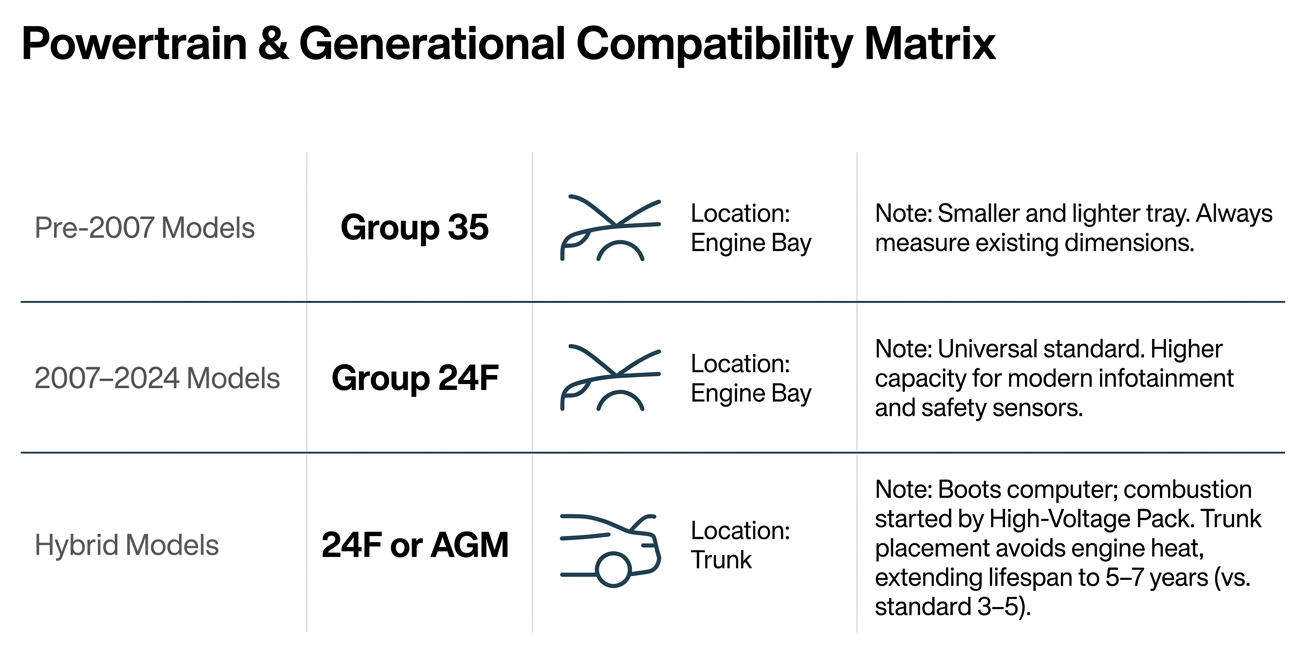
- Older Models (Pre-2007): Many 1990s and early 2000s Camrys were built for Group 35 batteries. These units are slightly smaller and lighter than the 24F. Always measure your existing battery tray dimensions if you own an older model.
- Modern Generations (2007–2024): The Group 24F is the universal standard for these models. It provides the higher electrical capacity needed to power the complex infotainment systems and safety sensors found in modern cabins.
- Camry Hybrid Models: Hybrids are a special case. They use a 12V Group 24F (or sometimes a smaller AGM unit) to “boot up” the computer systems, but the actual combustion engine is started by the high-voltage Hybrid Pack.
Mechanic’s Note: If you own a Hybrid Camry, your 12V battery is often located in the trunk rather than under the hood. This clever placement keeps the battery away from engine heat, which is the number one killer of lead-acid batteries, often allowing it to last 5–7 years instead of the usual 3–5.
Step-by-Step: Replacing Your Camry Battery
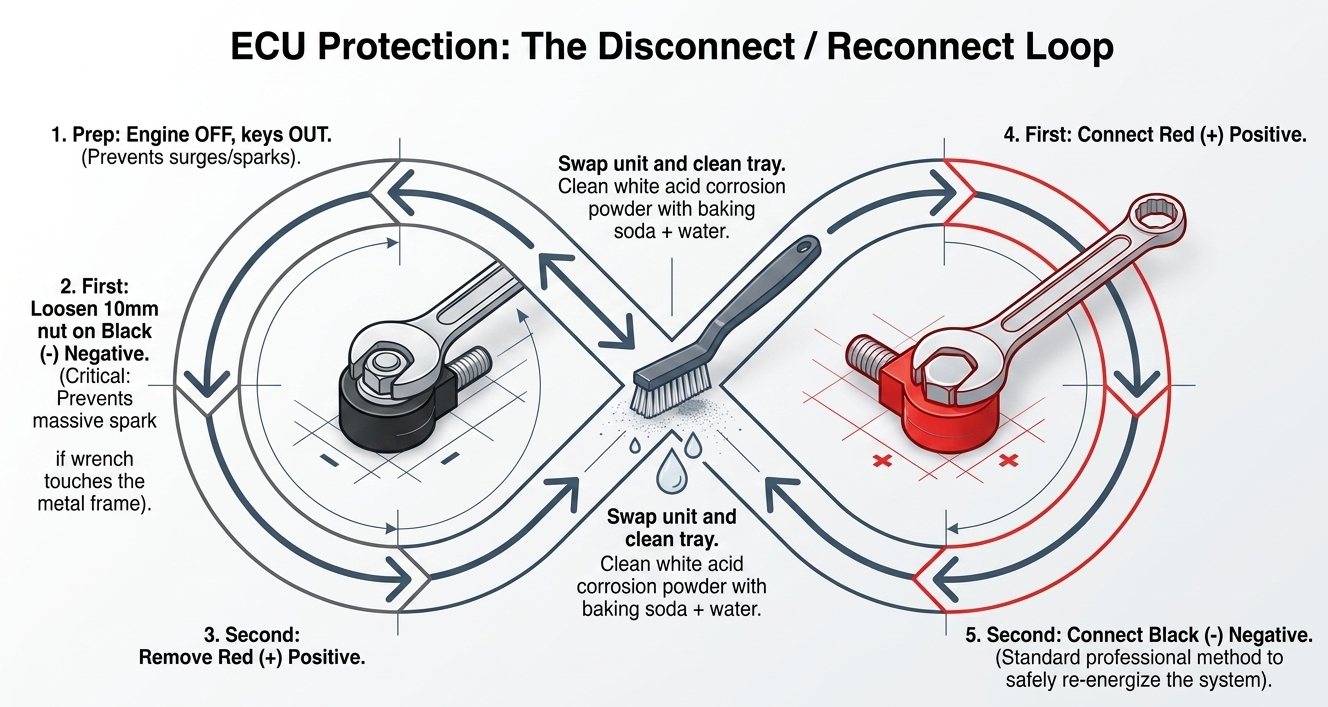
If you’re handling the replacement yourself, the order in which you connect and disconnect the cables is vital for protecting the car’s sensitive Engine Control Unit (ECU) and preventing accidental short circuits:
- Preparation: Ensure the engine is completely off and the keys are out of the ignition. This prevents any sudden power surges or sparks during the process.
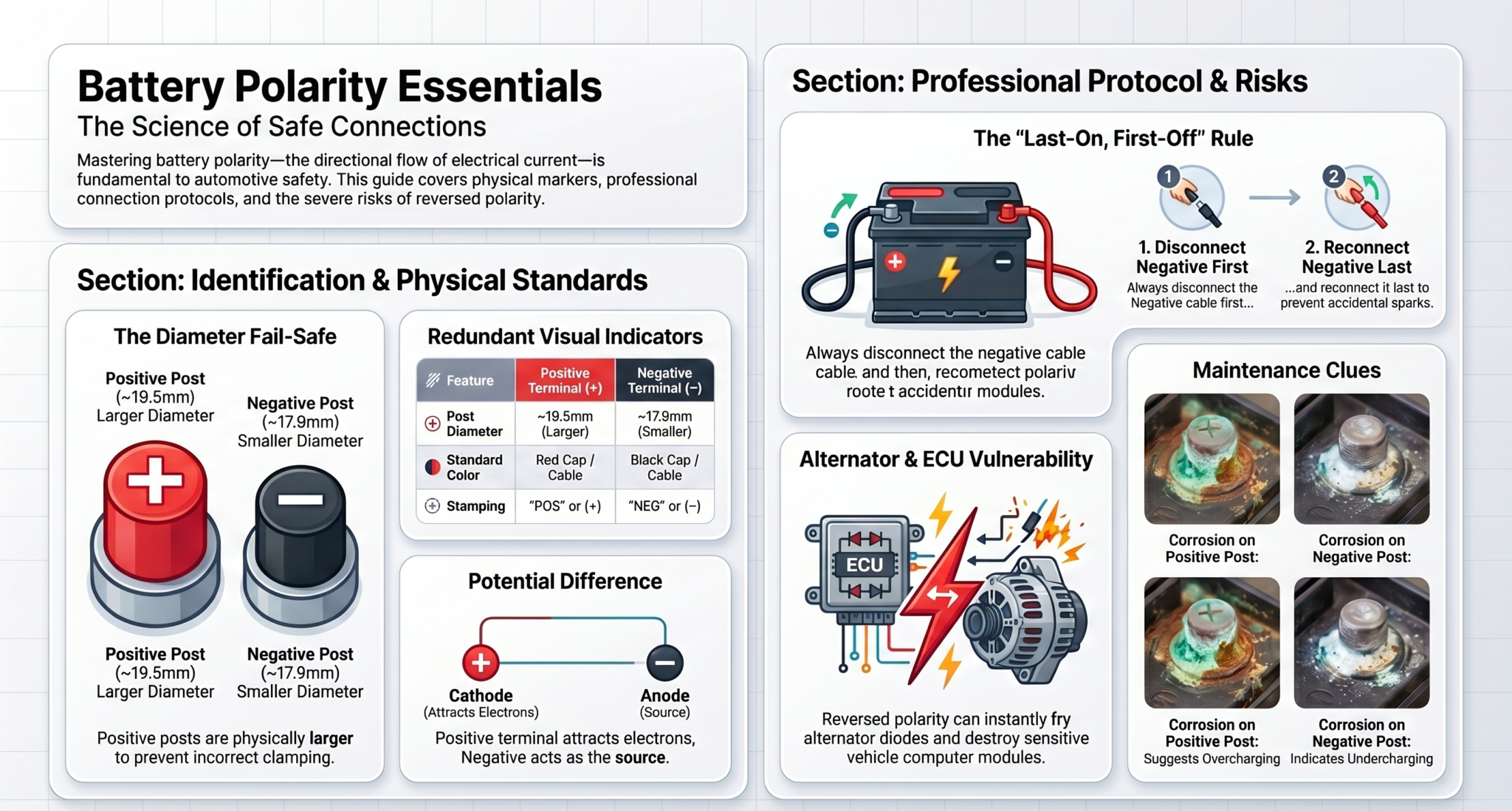
- Disconnect Negative First: Always loosen the 10mm nut on the Black (-) terminal first. This is a critical safety step; it ensures that if your wrench touches the metal frame of the car while loosening the terminal, it won’t create a massive spark.
- Disconnect Positive Second: Once the negative is safe, remove the Red (+) cable.
- Swap the Unit: Remove the hold-down bracket, take out the old battery, and clean the tray. If you see white powder (acid corrosion), clean it with a mixture of baking soda and water before installing the new unit.
- Reconnect in Reverse: Place the new battery in, secure the bracket, and attach the Positive (+) cable first, followed by the Negative (-). This is the standard professional method to re-energize the car’s system.
Signs Your Battery is Failing
It is always better to replace a battery on your own terms rather than waiting for a “no-start” condition in a dark parking lot. Keep an eye out for these common warning signs that your Camry’s power source is reaching the end of its life:
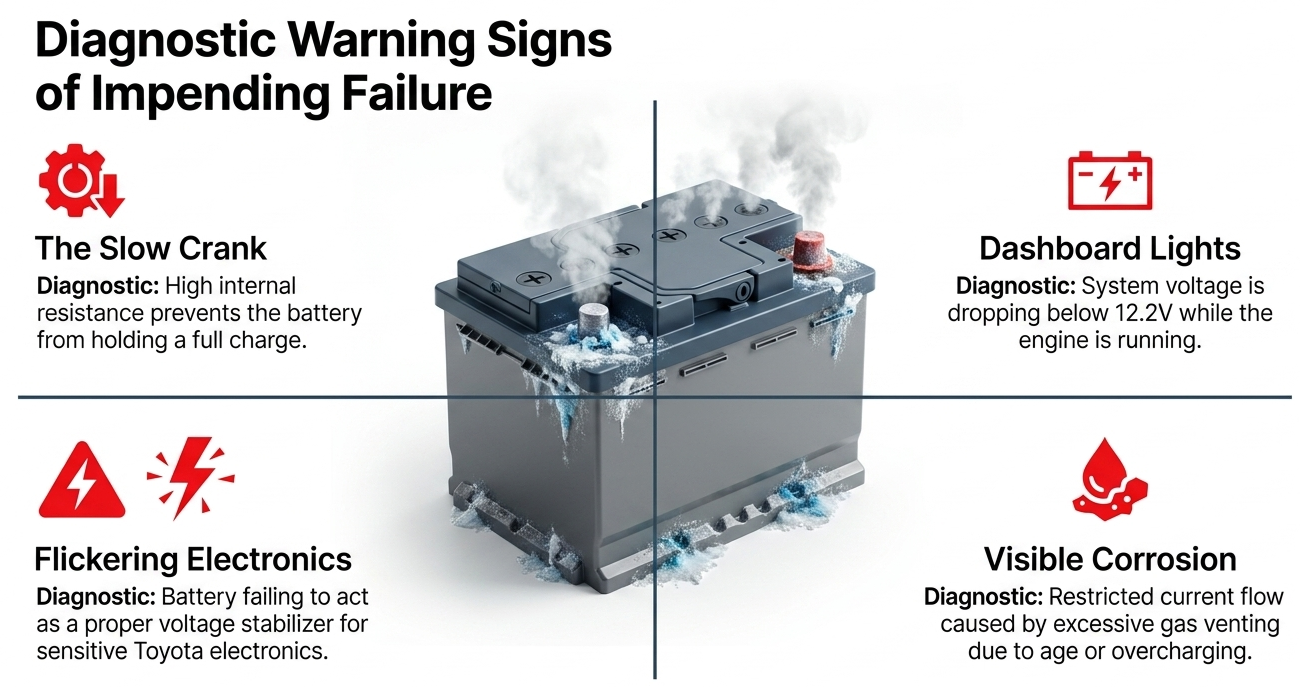
- The Slow Crank: If the engine turns over sluggishly (rur-rur-rur) before finally catching, it’s a sign that the battery’s internal resistance is too high and it can no longer hold a full charge.
- Dashboard Warning Lights: The battery icon or a “Check Charging System” message on your multi-information display means the system voltage is dropping below 12.2V while the engine is running.
- Flickering Electronics: Modern Toyotas are very sensitive to voltage drops. If your headlights dim slightly when you use the power windows or the AC kicks in, the battery is struggling to act as a proper voltage stabilizer.
- Visible Terminal Corrosion: A heavy buildup of blue or white powder on the terminals restricts current flow. This often happens because the battery casing is venting gasses excessively due to age or overcharging.
Frequently Asked Questions
Can I put a Group 35 battery in a 2015 Camry?
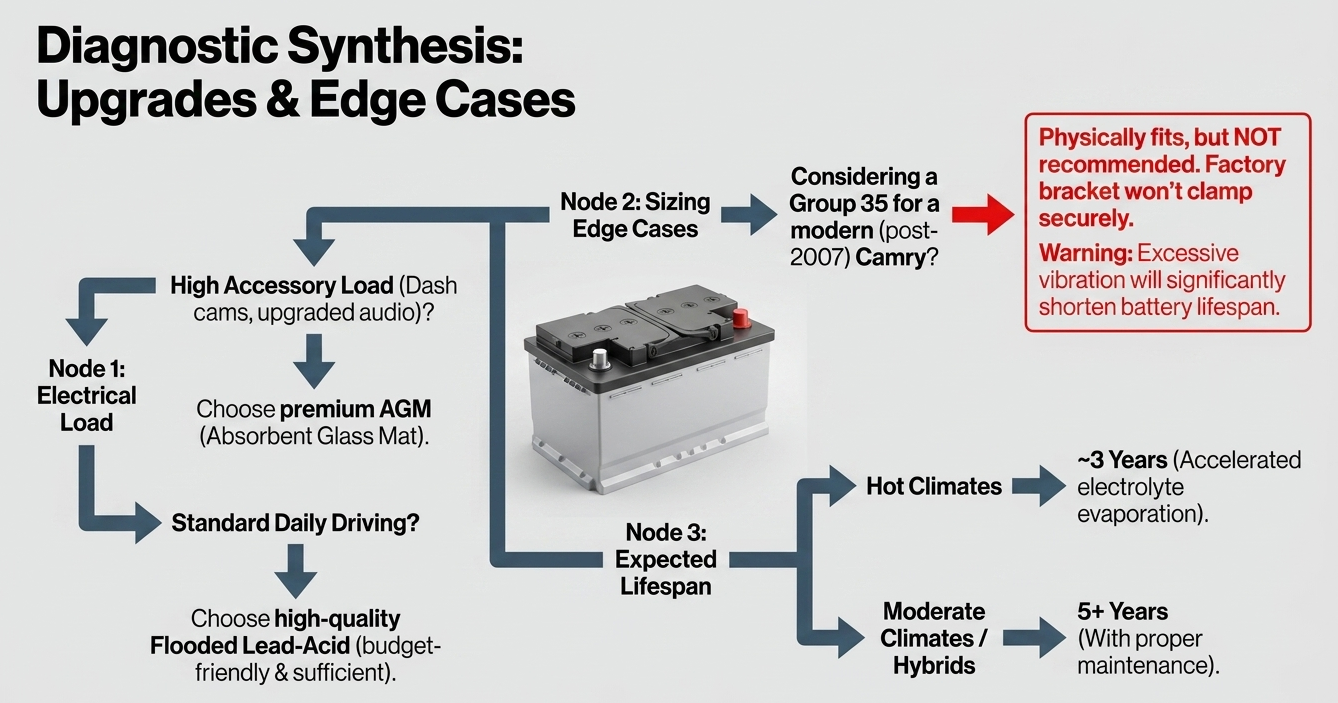
Physically, it will fit because a Group 35 is smaller than a 24F. However, it’s not ideal. The Group 35 has less reserve capacity, and your factory hold-down bracket may not clamp it securely. Excessive vibration from a loose fit will significantly shorten the battery’s lifespan.
What is the best battery type for a Camry?
If you have added many accessories like dash cams or upgraded audio systems, an AGM (Absorbent Glass Mat) battery is the premium choice. For standard daily driving, a high-quality “Flooded” lead-acid battery is perfectly sufficient and more budget-friendly.
Why does my Camry need a “24F” instead of a regular “24”?
The “F” specifically stands for the terminal orientation (Flipped). On a regular Group 24, the positive post is on the left. On a 24F, it’s on the right. If you buy a regular 24, your cables will be on the wrong side and almost certainly won’t reach the terminals.
How long should my Toyota Camry battery last?
You should expect between 3 to 5 years of service. In extremely hot climates, batteries tend to fail closer to the 3-year mark due to electrolyte evaporation. In more moderate climates, with proper maintenance, you might see 5 years or more.
Conclusion
For the vast majority of Toyota Camry owners, the Group 24F is the correct and only choice for a trouble-free installation. While older models might lean toward Group 35, the 24F offers the cranking power and reserve capacity that the Camry’s modern electrical system demands. Always prioritize CCA ratings if you live in cold regions and stick to the 24F standard to ensure your cables and mounting brackets line up perfectly for a safe, reliable start every time.

Eric Strong works in the automotive repair industry more than 20 years. His work included repairing electrical systems in various vehicle systems. A hybrid electric car battery replacement experience expanded his understanding of automotive battery technology.
Page Contents