

Battery Council International (BCI) group numbers are essential technical codes that standardize the physical chassis dimensions, terminal placement, and type of post used in automotive batteries. For owners of Japanese and domestic vehicles, the choice often narrows down to Group 35 and Group 24F. Selecting the wrong size isn’t just a matter of fitment; it can lead to electrical shorts if the terminals are reversed or mechanical damage if the battery tray cannot secure the weight.
The primary difference lies in the footprint: Group 24F is significantly longer and offers higher electrical capacity, while Group 35 is a compact, standard-duty unit found in mid-sized sedans. Understanding these nuances ensures your vehicle’s charging system operates within its engineered parameters.
What is a Group 35 Battery?
A Group 35 battery is the standard power source for a vast range of modern passenger vehicles, particularly those from Toyota, Honda, Nissan, and Subaru. It is engineered for vehicles where engine bay space is at a premium but reliable cold-start performance is still required.
- Physical Dimensions: Typically measures 9.1″ L x 6.9″ W x 8.9″ H.
- Terminal Configuration: Standard top-post design. When facing the battery from the front, the positive (+) terminal is located on the left side.
- Cranking Power: Usually rated between 550 and 640 Cold Cranking Amps (CCA).
- Typical Fitment: Toyota Camry (4-cylinder), Honda Civic, Subaru Forester, and Mazda CX-5.
Tech Tip: Group 35 batteries are often preferred in colder climates for smaller engines because they provide high CCA relative to their smaller volume, allowing for faster electrolyte heating during charging.
| Image | Product | |
|---|---|---|
Best Choice 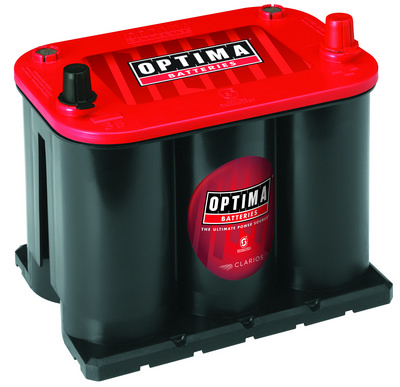 | Optima Batteries 8020-164 35 RedTop Starting Battery
| Check Price |
Best Value 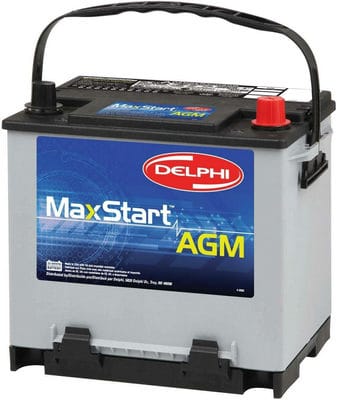 | Delphi BU9035 MaxStart AGM Premium Automotive Battery
| Check Price |
Also Great 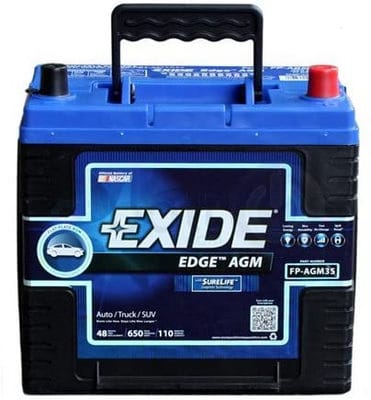 | Exide Edge FP-AGM35 Flat Plate AGM Sealed Automotive Battery
| Check Price |
Good Choice 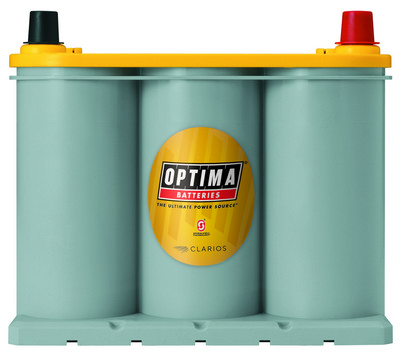 | Optima Batteries 8040-218 D35 YellowTop Dual Purpose Battery
| Check Price |
Good Choice 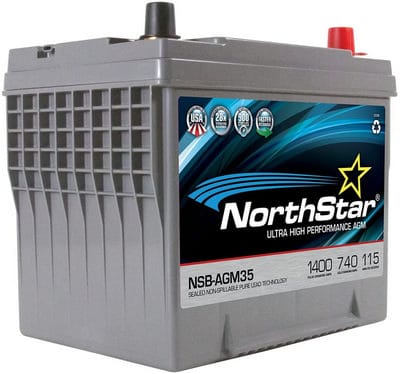 | NORTHSTAR NSB-AGM35 Pure Lead Automotive AGM Battery
| Check Price |
Good Choice  | Arc-Angel Group 35 LiFePO4 Battery
| Check Price |
What is a Group 24F Battery?
The Group 24F battery is a heavy-duty alternative, often found in larger SUVs, pickup trucks, and vehicles with high-displacement V6 or V8 engines. The “F” suffix is a critical distinction, indicating a “flipped” or reversed terminal layout compared to the standard BCI Group 24 casing.
- Physical Dimensions: Measures approximately 10.75″ L x 6.8″ W x 9.0″ H. It is nearly 1.5 inches longer than the Group 35.
- Terminal Configuration: The positive (+) terminal is located on the right side. This mirror-image layout is mandatory for vehicles where the positive cable is routed to the passenger side of the tray.
- Cranking Power: High-output units generally deliver 700 to 850 CCA.
- Typical Fitment: Toyota Tacoma, Honda Odyssey, Nissan Pathfinder, and V6-equipped Toyota Highlanders.
Group 35 vs. Group 24F: Direct Technical Comparison
This table outlines the engineering differences that impact fitment and electrical load handling.
| Technical Spec | BCI Group 35 | BCI Group 24F |
|---|---|---|
| Length | 9.1 in (230 mm) | 10.75 in (273 mm) |
| Positive Post Location | Left Side | Right Side |
| Reserve Capacity (RC) | 90 – 110 Minutes | 120 – 140 Minutes |
| Average Weight | ~35 lbs (15.9 kg) | ~46 lbs (20.8 kg) |
Installation and Compatibility Challenges
When deciding between these two sizes, the “bigger is better” logic only applies if the vehicle’s hardware can support it. There are three primary constraints to consider before attempting a swap.
1. Tray Dimensions and Hold-Down Brackets
A Group 24F is significantly longer. Most vehicles designed for a Group 35 have a molded plastic tray or a heat shield that is physically too small for the 24F. Forcing a larger battery into a small tray can puncture the casing over time due to engine vibration. Additionally, ensure your J-hooks and crossbar (hold-down hardware) have enough thread length to secure the slightly taller 24F.
2. Cable Slack and Polarity Risks
Because the positive posts are on opposite sides, the main battery cables are often cut to a precise length for a specific group. If you install a Group 24F in a car wired for a Group 35, the positive cable will likely be 3-4 inches too short. Never stretch a battery cable; this puts stress on the internal lead post connections and can lead to an electrical fire.
3. Reserve Capacity (RC) Needs
If your vehicle is equipped with modern infotainment, dash cams, or aftermarket alarms, the higher Reserve Capacity of the 24F is beneficial. RC measures how long the battery can support a 25-amp load if the alternator fails. A 24F generally offers 20-30% more backup time than a 35.
Expert Note: In many Toyota trucks (like the Tacoma), the tray is large enough to fit a 24F, but the factory might have shipped it with a Group 35 to save weight. Upgrading to the 24F is a common “overlanding” mod, but only if you verify the cable slack first.
Frequently Asked Questions
Can I use a Group 35 in place of a 24F?
While a Group 35 will physically fit into a larger 24F tray, it is not recommended. The lower CCA and RC may not be sufficient for the starter motor or the electrical accessories of a larger vehicle. Furthermore, the reversed polarity of the terminals will make connection difficult or impossible without modifying the cables.
Are Group 35 and 24F interchangeable?
Generally, no. They have different lengths (9.1″ vs 10.75″) and opposite terminal layouts. A Group 35 has the positive post on the left, while a 24F has it on the right. Always stick to the BCI size recommended in your owner’s manual to ensure proper fitment and safety.
Does a Group 24F last longer than a Group 35?
Battery longevity is determined by the quality of the lead plates and the environment (heat is the primary killer of batteries). However, because a 24F contains more lead and electrolyte, it can theoretically handle more deep-discharge cycles before failing, making it slightly more durable in high-drain applications.
Which battery is better for cold weather?
The Group 24F is technically superior for extreme cold because it typically offers higher Cold Cranking Amps (750-850 CCA). Higher CCA ensures the battery can provide enough current to turn over a frozen engine with thickened oil.

Eric Strong works in the automotive repair industry more than 12 years. His work included repairing electrical systems in various vehicle systems. A hybrid electric car battery replacement experience expanded his understanding of automotive battery technology.
Page Contents