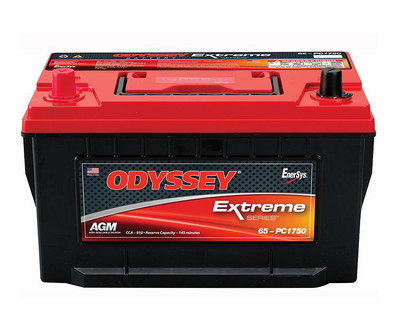
Group 24F Battery Dimensions
| Battery Design |
|---|
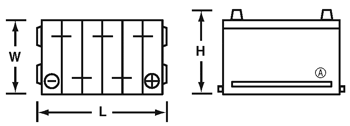 |
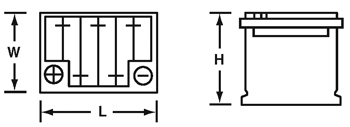
| Dimensions and Sizes (Length x Width x Height) |
|---|
| 10.75'' x 6.8125'' x 9'' Inches 273 x 173 x 229 Millimeters |
Group 24F Battery Post Terminals
| Post Terminal Types and Locations | Posts Used |
|---|---|
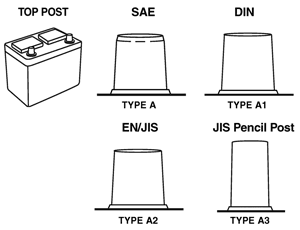
|
Type "A", "A2" or manufacturer's custom post design |
Group 24F Battery Voltage and Current Characteristics
| Volts | Cells | CCA Range |
|---|---|---|
| 12 | 6 | 250-900 |
Best Group 24F Batteries
List of recommended batteries
|
Good Choice

|
NORTHSTAR Pure Lead Automotive Group 24F Battery NSB-AGM24F
|
Check Price |
Best Group 24F Battery Equivalents
Compatible interchangeable batteries with the same post terminal locations.
|
Good Choice
|
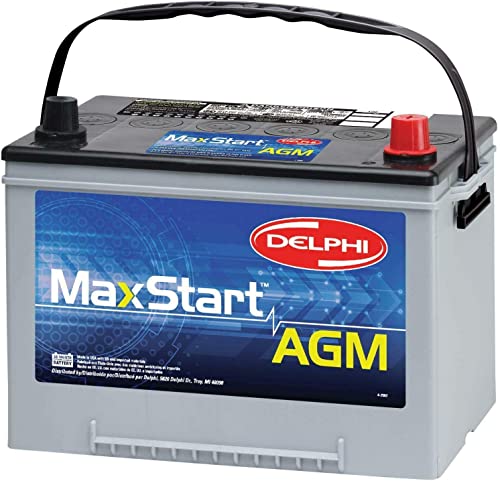
Delphi BU9034R MaxStart AGM Premium Automotive Battery, Group Size 24F / 34R
|
Check Price |
Group 24F Alternatives and Closest Battery Groups by Dimensions
Interchangeable Battery Groups for 24F Battery
These groups have the same dimensions and performance but can have different terminal post types, post locations, and polarity.
| Battery Group Number | Dimensions | Shape | Volts | Cells | Post Terminal Type |
|---|---|---|---|---|---|
| Group 24F Battery | 10.75'' x 6.8125'' x 9'' in. 273 x 173 x 229 mm |
|
12 | 6 | "A", "A2" |
| Group 46 Battery | 10.75'' x 6.8125'' x 9'' in. 273 x 173 x 229 mm |
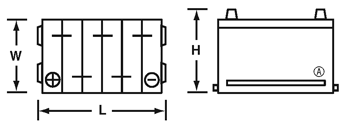
|
12 | 6 | "A", "A1" |
Closest but not Identical Size Battery Groups
Battery groups in this section below are not identical to the group 24F battery, they can be a little bigger or smaller. Please pay attention to the post terminal types and their location
Closest Groups that Have Slightly Smaller Dimensions
Smaller batteries can have less capacity, performance, and power in comparison with 24F group.
| Battery Group Number | Dimensions | Shape | Volts | Cells | Post Terminal Type |
|---|---|---|---|---|---|
| Group 24F Battery | 10.75'' x 6.8125'' x 9'' in. 273 x 173 x 229 mm |
|
12 | 6 | "A", "A2" |
| Group 24T Battery | 10.25'' x 6.8125'' x 9.75'' in. 260 x 173 x 248 mm |

|
12 | 6 | "A" |
| Group 28 Battery | 10.25'' x 6.8125'' x 9.4375'' in. 261 x 173 x 240 mm |
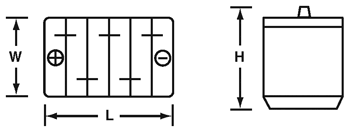
|
12 | 6 | "T" |
| Group 24H Battery | 10.25'' x 6.8125'' x 9.375'' in. 260 x 173 x 238 mm |
|
12 | 6 | "A" |
| Group 24R Battery | 10.25'' x 6.8125'' x 9'' in. 260 x 173 x 229 mm Positive post on the Right |

|
12 | 6 | "A", "A2" |
| Group 24 Battery | 10.25'' x 6.8125'' x 8.875'' in. 260 x 173 x 225 mm |
|
12 | 6 | "A", "A2" |
| Group 34R Battery | 10.25'' x 6.8125'' x 7.875'' in. 260 x 173 x 200 mm Positive post on the Right |
|
12 | 6 | "A" |
| Group 34 Battery | 10.25'' x 6.8125'' x 7.875'' in. 260 x 173 x 200 mm |
|
12 | 6 | "A" |
| Group 63 Battery | 10.1875'' x 6.375'' x 8.875'' in. 258 x 162 x 225 mm |
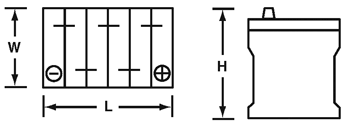
|
12 | 6 | "A" |
| Group 56 Battery | 10'' x 6.0625'' x 8.375'' in. 254 x 154 x 212 mm |
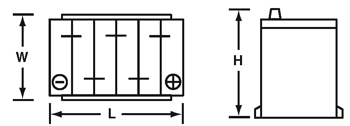
|
12 | 6 | "A" |
Closest Large Dimensions
Bigger batteries can have more capacity and power compared to 24F batteries.
| Battery Group Number | Dimensions | Shape | Volts | Cells | Post Terminal Type |
|---|---|---|---|---|---|
| Group 24F Battery | 10.75'' x 6.8125'' x 9'' in. 273 x 173 x 229 mm |
|
12 | 6 | "A", "A2" |
| Group 48 Battery | 11'' x 6.9375'' x 7.5'' in. 278 x 175 x 190 mm |
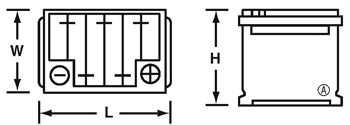
|
12 | 6 | "A", "A1", "A2" |
| Group 98R Battery | 11.125'' x 6.9375'' x 7.5'' in. 283 x 175 x 190 mm Positive post on the Right |
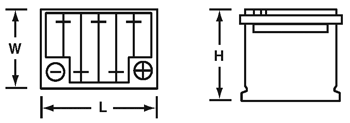
|
12 | 6 | "A1", "A2" |
| Group 27H Battery | 11.75'' x 6.8125'' x 9.25'' in. 298 x 173 x 235 mm |
|
12 | 6 | "A" |
| Group 27 Battery | 12.0625'' x 6.8125'' x 8.875'' in. 306 x 173 x 225 mm |
|
12 | 6 | "A", "A2" |
| Group 27R Battery | 12.0625'' x 6.8125'' x 8.875'' in. 306 x 173 x 225 mm Positive post on the Right |
|
12 | 6 | "A", "A2" |
| Group 79 Battery | 12.0625'' x 7.0625'' x 7.375'' in. 307 x 179 x 188 mm |
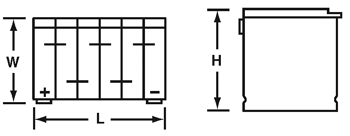
|
12 | 6 | "S" |
| Group 77 Battery | 12.0625'' x 7.25'' x 8.75'' in. 306 x 184 x 222 mm |
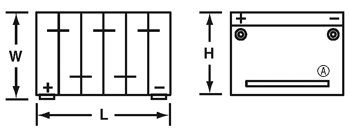
|
12 | 6 | "A" |
| Group 65 Battery | 12.0625'' x 7.5625'' x 7.5625'' in. 306 x 192 x 192 mm |

|
12 | 6 | "A" |
| Group 66 Battery | 12.0625'' x 7.5625'' x 7.6875'' in. 306 x 192 x 194 mm |
|
12 | 6 | "A" |
How to Get 24 Volts from 12V of a 24F Battery Group
If you need 24 Volts, you can connect two group 24F batteries in series to double the voltage. The voltage of a series connection is equal to the sum of the voltages of all its batteries. If one 12V lead-acid battery is connected to another 12V lead-acid battery, you have 24V total power output. Each battery must be fully charged and completely isolated from the other before connecting them in series, or there will be damage to at least one of them.
Increasing a Capacity of 24F Batteries with a Parallel Connection
If you need to increase current capacity and reduce charging time, connect batteries in parallel. When group 24F batteries are in parallel, their voltage is equal to the voltage of one battery, while current capacity equals to the sum of all its battery capacities. If you have two 12V lead-acid batteries with 60 Ah capacity and you connect them in parallel, you'll get 12 Volts with 120 Ah.
ArrayWhen dealing with automotive power standards, precision in physical dimensions is just as vital as electrical output. The BCI Group 24F is a cornerstone battery size for the North American and Asian automotive markets, particularly for Toyota, Nissan, and Honda trucks and SUVs. Unlike standard electronics, where a few millimeters might not matter, the Group 24F must fit into a reinforced steel or plastic tray with zero tolerance for overhang.
Understanding the exact footprint of a 24F battery ensures that the hold-down hardware stays secure and the high-amperage cables reach the terminals without mechanical stress. This guide provides the definitive measurements and installation nuances that professionals look for before recommending a replacement.
Physical Specifications: Measuring the Group 24F Casing
The “24” in the group size refers to the specific chassis family, while the “F” stands for “Flipped” or reversed terminal orientation. Because this battery is designed for larger engine bays, its dimensions are significantly larger than the common Group 35 or 51R batteries. Below is the technical breakdown of the standard casing size as defined by the Battery Council International.
| Dimension | Measurement (Inches) | Measurement (Metric) |
|---|---|---|
| Maximum Length | 10.75 in | 273 mm |
| Maximum Width | 6.81 in | 173 mm |
| Maximum Height | 8.87 in | 225 mm |
While these are the maximum BCI standards, individual manufacturers like Odyssey or Delphi may vary the casing by 1–2 millimeters to accommodate reinforced ribs or specialized AGM internal plates. Always verify that your battery hold-down crossbar has enough thread length to handle the nearly 9-inch height of this unit.
Why Fitment Precision Matters for 24F Installations
The Group 24F is a “heavyweight” battery, typically weighing between 44 and 48 lbs (20–22 kg). This mass must be immobilized to prevent catastrophic failure. Proper dimensions are crucial for several engineering reasons:
- Vibration Dampening: If the battery is even 5mm too small for the tray, it will shift during cornering. Constant vibration causes lead plates to shed active material, leading to internal shorts and a dead cell.
- Terminal Clearance: The height of 8.87 inches is standardized to ensure the terminals don’t make contact with the underside of the hood. On some low-profile vehicles, using a non-standard height battery can cause a massive electrical arc if the hood is slammed shut.
- Cable Tension: Since the 24F is nearly 11 inches long, the positive and negative posts are far apart. Using a shorter Group 35 in a 24F tray often results in cables that are physically too short to reach.
Expert Note: If your vehicle originally came with a Group 24F, do not try to “downgrade” to a Group 35 just because it’s cheaper or lighter. The 24F provides a higher Reserve Capacity (RC), which is essential for powering modern Nissan and Toyota “Intelligent Key” systems that stay active even when the car is parked.
Comparing Group 24F Dimensions with Common Alternatives
In the shop, we often see owners trying to swap batteries based on what is available in stock. The following table illustrates why most swaps require hardware modification due to the 24F’s unique footprint.
| BCI Group | Length (in) | Polarity | Fitment Impact |
|---|---|---|---|
| 24F | 10.75″ | Right Positive (+) | Standard for V6/V8 Trucks. |
| 35 | 9.06″ | Left Positive (+) | Too short; cables won’t reach. |
| 27F | 12.06″ | Right Positive (+) | Too long for most 24F trays. |
Safety and Mounting Procedures for Group 24F Batteries
Because the 24F is one of the heavier consumer battery sizes, installation requires careful attention to the hold-down system. A battery that breaks loose in an accident becomes a high-speed projectile under the hood.
- Clean the Tray: Before installation, remove any stones or debris from the tray. Even a small pebble under a 45-lb battery can eventually wear a hole through the plastic casing.
- Verify Polarity: Confirm that the Positive (+) terminal is on the right side. If you are accidentally holding a standard Group 24 (non-F), the terminals will be backwards, which can blow the main 100A fuse in seconds.
- Tighten the Hold-Down: Use a 10mm socket to tighten the J-hooks. The battery should not move when pushed firmly, but do not over-torque, as you can crack the battery’s top lid.
- Check Cable Slack: Ensure the cables have a slight “loop” of slack. If the cables are tight after connecting them to a 24F, you risk cracking the internal lead busbars of the battery over time.
Frequently Asked Questions About 24F Battery Sizing
Will a Group 24F battery fit in my 4-cylinder Camry?
Most 4-cylinder Camrys are built with a tray specifically for the smaller Group 35. While the 24F is a common “upgrade” for more power, it usually won’t fit without removing the factory plastic insulation or replacing the tray itself.
What is the weight of a standard Group 24F battery?
Most flooded lead-acid 24F batteries weigh between 44 and 46 lbs. High-performance AGM versions, like those from Odyssey, can weigh up to 52 lbs because they contain more high-density lead plates.
Can I use a regular Group 24 instead of a 24F?
Only if you can physically rotate the battery 180 degrees and still have enough cable reach. The “F” in 24F is specifically there because the terminals are reversed. For 99% of Toyota and Nissan vehicles, a regular Group 24 will not work because the cables are too short to reach the opposite sides.
How do I know if my battery tray is compatible?
Measure the flat interior space of the tray. It must be at least 11 inches long and 7 inches wide to accommodate the Group 24F. If the tray has raised edges or “lips” that are narrower than this, the battery will not sit flat and will likely leak acid under pressure.
Choosing the Best 24F Unit for Your Setup
The BCI Group 24F is an industry standard for a reason: it provides the perfect balance of starting power (CCA) and electrical endurance for modern vehicles. By adhering to the 10.75″ x 6.81″ dimensions and verifying the “Right Positive” polarity, you ensure a safe and professional installation. Whether you are replacing an OEM battery or performing an electrical upgrade, sticking to the 24F dimensions guarantees that your Nissan or Toyota remains reliable through extreme heat and freezing winters.

Eric Strong works in the automotive repair industry more than 20 years. His work included repairing electrical systems in various vehicle systems. A hybrid electric car battery replacement experience expanded his understanding of automotive battery technology.
Page Contents