

Picture the scene: it is a freezing winter morning, you are already running late for an important meeting, or you just want to quickly drop the kids off at school. You slide into a freezing car, turn the ignition key, and instead of the reassuring roar of your engine, you hear that dreaded, rhythmic “click-click-click.” Sound familiar? In that moment, you might want to pull your hair out, but let’s be honest—your battery has been dropping hints about its retirement for a while. If the power source hiding under your hood is a Group 97R battery, you are facing not just a routine trip to the nearest auto parts store, but a bit of a mechanical quest.
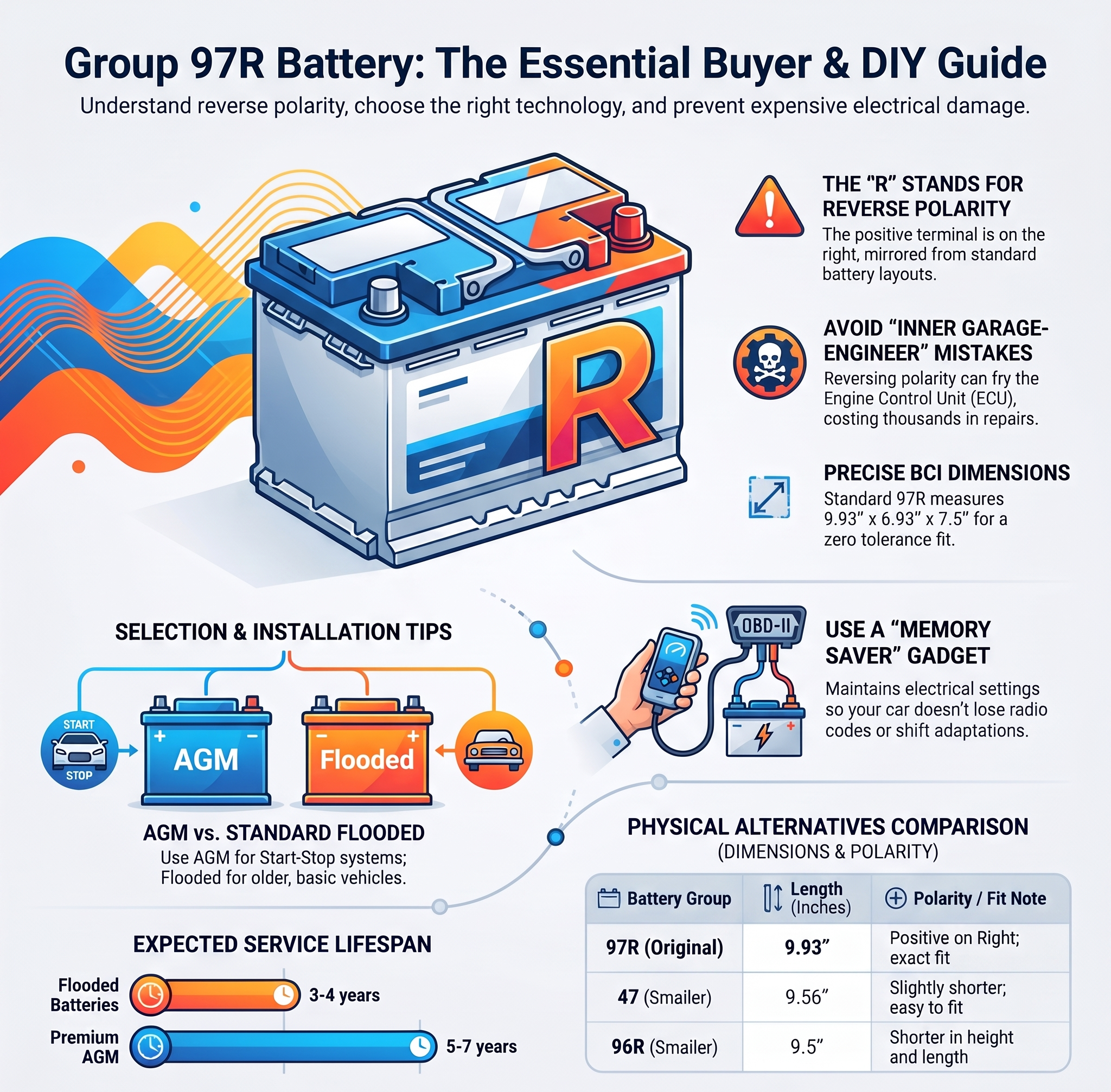
Replacing a car battery today is nothing like it was thirty years ago. A modern vehicle is packed tighter with sensitive electronics than a corporate server room. You can no longer just grab “some black box with terminals, as long as it fits.” In this deep dive, we will chew over every minute detail: technical specifications, direct alternatives, why the reverse polarity could save your wallet from a heart attack, and how to avoid frying your onboard computer during a DIY installation.
Technical Information: Official Specifications
Understanding the exact physical and electrical boundaries of your power source is non-negotiable. The Battery Council International (BCI) sets rigid sizing standards to ensure the unit drops perfectly into your vehicle’s designated tray without crushing nearby components or shorting out against the hood. The 97R is a highly specific form factor designed with zero tolerance for sloppy fitment.
| Specification | Measurement / Detail |
|---|---|
| Dimensions (L x W x H) | 9.9375″ x 6.9375″ x 7.5″ (252 x 175 x 190 mm) |
| Voltage & Cells | 12 Volts, 6 Cells |
| Polarity | Right Positive (“R” designation) |
| Terminal Type | Standard Top Post (“A1” or “A2”) |
Comparison with Alternatives (Smaller and Larger Options)
If your local auto parts store is completely out of stock, you are not entirely out of luck. While there are no direct interchangeable equivalents that match the dimensions down to the millimeter, you can safely swap in a slightly different BCI group size, provided your battery compartment has the flexibility and you maintain the correct terminal orientation. Below is how the closest alternatives stack up against the original hardware.
| Battery Group | Dimensions (Inches) | Dimensions (mm) | Polarity / Fit Notes |
|---|---|---|---|
| Group 97R (Original) | 9.93″ x 6.93″ x 7.5″ | 252 x 175 x 190 | Positive on Right |
| Group 47 (Smaller Alternative) | 9.56″ x 6.93″ x 7.5″ | 242 x 175 x 190 | Slightly shorter in length, easy to fit |
| Group 96R (Smaller Alternative) | 9.5″ x 6.93″ x 6.93″ | 242 x 175 x 175 | Positive on Right, shorter in height and length |
| Group 58R (Larger Alternative) | 10.06″ x 7.18″ x 6.93″ | 255 x 183 x 177 | Positive on Right, check tray for extra width space |
The Letter “R” Is Not Just a Letter—It Is the Life of Your ECU
In the battery universe, the letter “R” stands for Reverse polarity. If you look at a standard battery (without the R), the positive terminal will sit on one specific side. On a 97R, it is mirrored and located on the right (when looking at the battery from the front, with the terminals closest to you). Why is this such a big deal?
Imagine you bought a standard Group 97 battery (no R) because it was 20 bucks cheaper or just happened to be on the shelf. You haul it to your car, drop it in the plastic tray, and try to pull the cables over the posts. But the cables are too short! Automakers pinch pennies on every inch of copper wire. Suddenly, your inner garage-engineer wakes up: you spin the battery around backwards so the cables finally reach. You forcefully shove the terminals on, sparks fly, a loud pop echoes under the hood… Congratulations, you just sent reverse voltage surging through your car’s entire electrical nervous system.
Expert’s Take (Veteran Auto Electrician): “Every couple of months, a tow truck drops off some poor soul who mixed up their polarity. In the best-case scenario, it blows the main power fuse—which costs pennies but is impossible to find in the middle of the night. In the worst-case scenario, it fries the ECU (Engine Control Unit), the body control module, and the infotainment system. That’s a repair bill in the thousands of dollars. Remember the golden rule: if the cables are stretched tight like a guitar string, you bought the wrong battery. Don’t try to cheat the system!”
AGM or Classic? What Should You Choose?
So, you are standing in the store or scrolling through an online catalog. You have two 97R options staring back at you: a standard flooded lead-acid battery for roughly $150, and a fancy AGM (Absorbent Glass Mat) version for $250 or more. Your inner penny-pincher starts acting up, whispering, “Just get the cheap one, it’s a consumable part!” But hold your horsepower before jumping to conclusions.
If your vehicle is equipped with a Start-Stop system (where the engine shuts off at every red light to save a thimble of gas and hug a tree), an AGM battery is absolutely vital. A standard battery subjected to that kind of stressful, repetitive drain will die a heroic death in about a year. AGM batteries don’t have a liquid acid soup sloshing around inside; instead, they use special fiberglass mats soaked in electrolyte. They handle deep discharges beautifully, laugh in the face of heavy vibrations, and recharge from the alternator incredibly fast. Yes, it hurts the wallet a bit more upfront, but you are paying for peace of mind and the guarantee that your car will start, even after a freezing night with the dashcam running.
- Classic Lead-Acid (Flooded): A fantastic choice for cars over 10-15 years old without a ton of complex electronics. It is cheap, cheerful, and reliable (as long as you don’t forget to check its health occasionally).
- AGM (Absorbent Glass Mat): Your only correct choice if your car has Start-Stop, a massive sound system, a dozen charging gadgets, and heated everything—right down to the steering wheel and mirrors. It lasts longer and cranks the starter with far more authority.
DIY Installation: Mission Possible (With a Few Caveats)
You bought your shiny new 97R. It is heavy (around 40 pounds of dense lead), so watch your back when hauling it out of the trunk. Can you swap it yourself right in your driveway? Absolutely! You will just need a couple of wrenches (usually a 10mm socket for the terminals and a 13mm for the hold-down bracket), some safety glasses (yes, safety first, folks), and a little bit of patience.
But there is one sneaky catch that 90% of beginners forget. The exact second you pull the cables off the old battery, your car gets instant amnesia. Your transmission shift adaptations will reset, your radio presets will vanish, your power windows might forget how to auto-roll up, and your factory stereo might demand a security PIN (which, according to Murphy’s Law, the previous owner lost five years ago).
Pro Hack: Use a “Memory Saver.” This is a dirt-cheap, brilliant little gadget that uses a small 9-volt battery and plugs right into your OBD-II port or cigarette lighter. It feeds just enough trickle power to the system while you swap the main battery. Your car won’t even realize it just had a heart transplant, and all your precious settings will remain perfectly intact.
Frequently Asked Questions (FAQ)
Can I use a different size battery instead of a 97R if it fits in the tray?
Physically? Yes. If something like a Group 47 or 48 battery slips into the plastic tray and can be securely clamped down by the hold-down bracket (so it doesn’t fly into your radiator fan during a hard stop), you can technically use it. BUT! The most critical thing is to ensure the polarity matches (positive cable easily reaches the positive post, negative to negative) without stretching the cables. And, of course, the Cold Cranking Amps (CCA) rating must be equal to or higher than your original 97R.
How long does a 97R battery typically last?
There is no magic formula here. A high-quality standard flooded battery will generally serve you well for 3 to 4 years. A premium AGM, when treated right and paired with a healthy alternator, can easily push 5 to 7 years. But remember the harsh truth: short 5-minute trips to the grocery store will murder your battery much faster than long highway road trips. The alternator simply doesn’t have enough time to replace the massive jolt of energy used to start a cold engine.
Why is a 97R harder to find in stock than a popular Group 35 or H6?
The 97R form factor is somewhat niche and used by a limited pool of car manufacturers. Because there isn’t a massive daily demand for it, some smaller auto parts shops choose not to stock them on the shelves so they don’t gather dust and lose their factory charge for months. Therefore, it is always a smart move to order them online in advance or call up large chain stores before driving over.
Final Verdict: Don’t Pinch Pennies on Your Peace of Mind
A car battery is not the place to save a few measly bucks, only to pay for it later with your own time and frostbitten fingers. Buying the correct Group 97R (with a maniacal verification of that letter “R” before you hit the checkout!) and opting for a high-quality AGM version if your ride is packed with tech, is the absolute best investment you can make for your morning routine. There is nothing more depressing than sprinting around an icy parking lot with jumper cables, begging rushed neighbors for a jump. Choose wisely, install carefully, and may your engine always fire up on the very first crank!

Eric Strong works in the automotive repair industry more than 20 years. His work included repairing electrical systems in various vehicle systems. A hybrid electric car battery replacement experience expanded his understanding of automotive battery technology.
Page Contents


